Showing posts with label NATURE. Show all posts

Sunday, 23 October 2011

Sabia Que?...


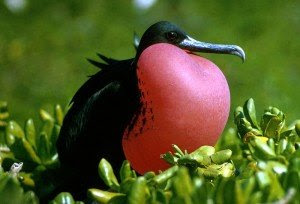
Esta avis rara, de nome Fregata Magnificens ou Man O’War, e'
nacional de Angola?...


... E se, nesse 'nosso pais tao lindo, tao lindo, inspirando emocoes', as cores da bandeira nacional tivessem sido nela inspiradas? ... Isto e', excepto no que o seu outro nome, "Man O'War", possa inspirar, ou sugerir, algo como "Homens em Guerra"!... Mesmo porque o seu peito sugere a cor e inspira a forma de um magnificente coracao/muxima...


Esta avis rara, de nome Fregata Magnificens ou Man O’War, e'
nacional de Angola?...


... E se, nesse 'nosso pais tao lindo, tao lindo, inspirando emocoes', as cores da bandeira nacional tivessem sido nela inspiradas? ... Isto e', excepto no que o seu outro nome, "Man O'War", possa inspirar, ou sugerir, algo como "Homens em Guerra"!... Mesmo porque o seu peito sugere a cor e inspira a forma de um magnificente coracao/muxima...


Wednesday, 8 June 2011

World Oceans Day


TAKE ONE


When I wrote this or this, I had already enjoyed that front beach all surrounded by Table Mountain views, where the Atlantic and Indian Oceans meet, before. But never at around this time of the year when it turns into a dreadful place that totally confirms what artist/entrepreneur Ha Schult says on 'take two' of this post bellow: "the oceans of our planet are the biggest garbage dump"!

So, if I may suggest, Blouberg would be a prime location for a Beach Garbage Hotel… Another such location that I can think of is Luanda and, more specifically, the island of Mussulo!


TAKE TWO


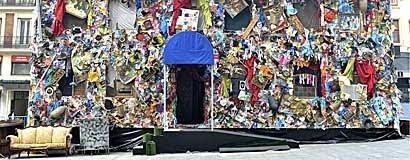
"I created the Beach Garbage Hotel because the oceans of our planet are the biggest garbage dump," the artist Ha Schult told the AFP news agency of his five-bedroom Madrid lodging built from rubbish, which opened today as part of the International Tourism Fair. Around one-third of the items used to construct the temporary accommodation came from discarded items found on the beaches of Europe; other building materials originated in dumps and flea markets. The point of the project was to draw attention to the huge amount of waste generated by mass tourism, especially on beaches, said Rose Piqueras, a spokeswoman for the hotel.
Rome is known as one of the most beautiful cities in the world, with unforgettable architecture and an atmosphere that can’t be found anywhere else. Lately, though, it’s become a real dump. German artist Ha Schult constructed a temporary hotel in the city to highlight the sad state of Europe’s beaches. The hotel, part of Corona’s Save the Beach campaign, is constructed of garbage collected from the shoreline.

[More Here]


TAKE ONE


When I wrote this or this, I had already enjoyed that front beach all surrounded by Table Mountain views, where the Atlantic and Indian Oceans meet, before. But never at around this time of the year when it turns into a dreadful place that totally confirms what artist/entrepreneur Ha Schult says on 'take two' of this post bellow: "the oceans of our planet are the biggest garbage dump"!

So, if I may suggest, Blouberg would be a prime location for a Beach Garbage Hotel… Another such location that I can think of is Luanda and, more specifically, the island of Mussulo!


TAKE TWO


"I created the Beach Garbage Hotel because the oceans of our planet are the biggest garbage dump," the artist Ha Schult told the AFP news agency of his five-bedroom Madrid lodging built from rubbish, which opened today as part of the International Tourism Fair. Around one-third of the items used to construct the temporary accommodation came from discarded items found on the beaches of Europe; other building materials originated in dumps and flea markets. The point of the project was to draw attention to the huge amount of waste generated by mass tourism, especially on beaches, said Rose Piqueras, a spokeswoman for the hotel.
Rome is known as one of the most beautiful cities in the world, with unforgettable architecture and an atmosphere that can’t be found anywhere else. Lately, though, it’s become a real dump. German artist Ha Schult constructed a temporary hotel in the city to highlight the sad state of Europe’s beaches. The hotel, part of Corona’s Save the Beach campaign, is constructed of garbage collected from the shoreline.

[More Here]


Saturday, 26 March 2011

The Obscene Moon


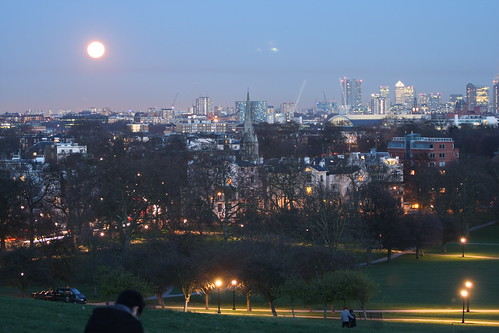
Exactly a week ago, on Saturday the 19th March 2011, coming from a stroll in the Regents Park, I was heading home through one of the main pathways of the Primrose Hill. I had just dispelled the idea of climbing up the hill to get that magnificent sight of central London from there: it had been a dry and sunny day but now the sun had downed and we tend to be “undercoated” for the cold that comes back to hunt us in the evenings of such early spring days. So, I thought, I’d better head straight home.


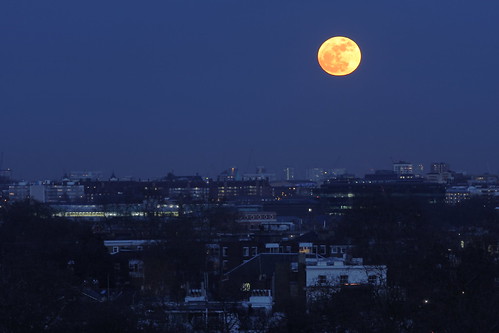
That’s when I spotted it through some trees: rising from whatever hiding place, a huge, humongous, startling moon! I didn’t think twice before changing my mind and my pathway and starting the climbing up the hill while not losing sight of that obscene moon – that’s how I immediately called it through my teeth: obscene!


Got up there and just marvelled at the spectacle of its wondrous rising, as more and more people, transfixed by it, came to the spot and its surroundings. Most had cameras, some of them potent, professional ones. I didn’t have any with me though.


SuperMoon Over Primrose Hill


But in the last two days I managed to borrow these pictures from someone who got them from a couple of people who where there, at that same Primrose Hill spot, and saw exactly what I saw last Saturday: That Obscene Moon!


Moon Over London


Exactly a week ago, on Saturday the 19th March 2011, coming from a stroll in the Regents Park, I was heading home through one of the main pathways of the Primrose Hill. I had just dispelled the idea of climbing up the hill to get that magnificent sight of central London from there: it had been a dry and sunny day but now the sun had downed and we tend to be “undercoated” for the cold that comes back to hunt us in the evenings of such early spring days. So, I thought, I’d better head straight home.


That’s when I spotted it through some trees: rising from whatever hiding place, a huge, humongous, startling moon! I didn’t think twice before changing my mind and my pathway and starting the climbing up the hill while not losing sight of that obscene moon – that’s how I immediately called it through my teeth: obscene!


Got up there and just marvelled at the spectacle of its wondrous rising, as more and more people, transfixed by it, came to the spot and its surroundings. Most had cameras, some of them potent, professional ones. I didn’t have any with me though.


SuperMoon Over Primrose Hill


But in the last two days I managed to borrow these pictures from someone who got them from a couple of people who where there, at that same Primrose Hill spot, and saw exactly what I saw last Saturday: That Obscene Moon!


Moon Over London

Friday, 11 March 2011

Tsunami Hits Again


This time in Japan

[Details here]


Related post:

The Tsunami


This time in Japan

[Details here]


Related post:

The Tsunami

Thursday, 10 February 2011

Wednesday, 26 January 2011

Atta girl!


A dog in Germany has given birth to 17 puppies.
Etana, the Rhodesian Ridgeback from Ebereschenhof, north of Berlin had nine dogs and eight bitches.
The litter is unusual in that all were born naturally with no need for a Caesarian section and all have survived.
The Rhodesian Ridgeback is a hunting dog originating from Zimbabwe and it was originally bred to help hunt lions.

[here]


Thursday, 28 October 2010

The Joy of Motherhood


A baby gorilla has been born at London Zoo for the first time in 20 years.

[Details Here]


A baby gorilla has been born at London Zoo for the first time in 20 years.

[Details Here]

Tuesday, 24 August 2010

A Menina que nasceu em cima da arvore: um update


Numa das estorias (... a par desta...), senao A ESTORIA (!), que fez recair sobre mim a chuva, ou melhor - enxurrada (!), de lama e pedras desta campanha, assim terminava, ha' ja' algum tempo, a minha "nota de rodape'" a este post:

Apenas para terminar numa nota com algum humor, uma estoria que me foi contada por um amigo Mocambicano*: lembram-se daquela mulher que, durante as cheias de 2000 em Mocambique, teve um bebe em cima de uma arvore? Pois bem, depois daquelas imagens que correram mundo, choveram-lhe donativos monetarios e materiais de todo o mundo, de tal modo que a senhora ficou rica e passou a gozar de uma grande admiracao por parte da comunidade, nao so’ por ter tido um bebe naquelas condicoes, mas tambem porque toda a riqueza de que a familia agora usufruia se devia a ela… Entao, nas grandes cheias que se seguiram, um grupo de uma comunidade vizinha que tinha perdido todos os seus bens foi bater-lhe a porta pedindo: minha senhora, agora que esta’ rica e nao lhe falta nada, por favor ajude-nos… qualquer coisa serve mesmo… qualquer coisa que nao precise so’! Entao a senhora gritou para o marido que estava dentro de casa: oh Joao, vem ca’ que estao a te precisar aqui fora!


Bom, claro que se tratava de uma anedota com base numa estoria veridica (daquelas que nao aparecem nas paginas do "Aconteceu Mesmo" de certa imprensa angolana, pelo que nao informam nem substanciam o seu "jornalismo de opiniao"...). Mas o update da estoria e-nos agora feito pelo correspondente da BBC para Africa:

Na verdade, a senhora, de seu nome Carolina Pedro, para alem dos varios donativos que recebeu na altura, nao ficou nada "rica" (embora tambem nao tenha ficado mais pobre do que era, em particular se em comparacao com os seus antigos vizinhos e familiares), mas "ganhou" uma boa casa definitiva de tijolo com um grande quintal, um emprego como empregada de limpeza num escritorio governamental na cidade e um lugar na escola local para a filha que, ha' 10 anos, trouxe ao mundo em cima de uma arvore, a Rosita. Para alem desses ganhos materiais, teve outras "recompensas" como a sua estoria ter passado a fazer parte do curriculum escolar nacional e a colocacao de uma placa alusiva no sope' da arvore onde o memoravel parto teve lugar.

Claro que a estoria do marido era a punchline da anedota, mas segundo este update nao andava la' muito longe da realidade: o dito marido, cujo nome verdadeiro e' Salvador (embora, como esta' bom de ver, dificilmente seria capaz de salvar a mulher e a filha na altura daquele parto, nao fossem os helicopteros da ajuda internacional...), se nao passa a vida a dormir (jiboiar talvez seja o termo mais apropriado) dentro de casa, e' acusado de ser um pai ausente e de se ter apropriado e gasto futilmente praticamente todo o dinheiro que foi dado a familia na sequencia do nascimento da filha naquelas circunstancias, pelo que, apesar dos "ganhos" da dona Carolina, a familia, a qual entretanto se juntou mais uma filha, a Cecilia, agora com 10 meses, por causa da vida perdularia do 'senhor' Salvador, nao tem o rendimento necessario para manter o seu novo lifestyle e tem passado por alguns momentos dificeis...

Mas nem tudo esta' perdido para a dona Carolina: a Rosita, que e' mesmo uma warrior desde o momento em que NASCEU MULHER, diz que a sua grande ambicao e' ser... Presidente da Republica!

(... E suspeito bem que o seu slogan de campanha nao sera' nada parecido com algo como "Okotunda Olunga"!...)


*(Quem me contou esta anedota, na Zambia, foi o meu amigo Luis de quem falo neste post, ao qual, como prometido, voltarei tao logo possa)


[Update, em Ingles, aqui]


Warrior (in Xemplify) - Khethi (South Africa)


Numa das estorias (... a par desta...), senao A ESTORIA (!), que fez recair sobre mim a chuva, ou melhor - enxurrada (!), de lama e pedras desta campanha, assim terminava, ha' ja' algum tempo, a minha "nota de rodape'" a este post:

Apenas para terminar numa nota com algum humor, uma estoria que me foi contada por um amigo Mocambicano*: lembram-se daquela mulher que, durante as cheias de 2000 em Mocambique, teve um bebe em cima de uma arvore? Pois bem, depois daquelas imagens que correram mundo, choveram-lhe donativos monetarios e materiais de todo o mundo, de tal modo que a senhora ficou rica e passou a gozar de uma grande admiracao por parte da comunidade, nao so’ por ter tido um bebe naquelas condicoes, mas tambem porque toda a riqueza de que a familia agora usufruia se devia a ela… Entao, nas grandes cheias que se seguiram, um grupo de uma comunidade vizinha que tinha perdido todos os seus bens foi bater-lhe a porta pedindo: minha senhora, agora que esta’ rica e nao lhe falta nada, por favor ajude-nos… qualquer coisa serve mesmo… qualquer coisa que nao precise so’! Entao a senhora gritou para o marido que estava dentro de casa: oh Joao, vem ca’ que estao a te precisar aqui fora!


Bom, claro que se tratava de uma anedota com base numa estoria veridica (daquelas que nao aparecem nas paginas do "Aconteceu Mesmo" de certa imprensa angolana, pelo que nao informam nem substanciam o seu "jornalismo de opiniao"...). Mas o update da estoria e-nos agora feito pelo correspondente da BBC para Africa:

Na verdade, a senhora, de seu nome Carolina Pedro, para alem dos varios donativos que recebeu na altura, nao ficou nada "rica" (embora tambem nao tenha ficado mais pobre do que era, em particular se em comparacao com os seus antigos vizinhos e familiares), mas "ganhou" uma boa casa definitiva de tijolo com um grande quintal, um emprego como empregada de limpeza num escritorio governamental na cidade e um lugar na escola local para a filha que, ha' 10 anos, trouxe ao mundo em cima de uma arvore, a Rosita. Para alem desses ganhos materiais, teve outras "recompensas" como a sua estoria ter passado a fazer parte do curriculum escolar nacional e a colocacao de uma placa alusiva no sope' da arvore onde o memoravel parto teve lugar.

Claro que a estoria do marido era a punchline da anedota, mas segundo este update nao andava la' muito longe da realidade: o dito marido, cujo nome verdadeiro e' Salvador (embora, como esta' bom de ver, dificilmente seria capaz de salvar a mulher e a filha na altura daquele parto, nao fossem os helicopteros da ajuda internacional...), se nao passa a vida a dormir (jiboiar talvez seja o termo mais apropriado) dentro de casa, e' acusado de ser um pai ausente e de se ter apropriado e gasto futilmente praticamente todo o dinheiro que foi dado a familia na sequencia do nascimento da filha naquelas circunstancias, pelo que, apesar dos "ganhos" da dona Carolina, a familia, a qual entretanto se juntou mais uma filha, a Cecilia, agora com 10 meses, por causa da vida perdularia do 'senhor' Salvador, nao tem o rendimento necessario para manter o seu novo lifestyle e tem passado por alguns momentos dificeis...

Mas nem tudo esta' perdido para a dona Carolina: a Rosita, que e' mesmo uma warrior desde o momento em que NASCEU MULHER, diz que a sua grande ambicao e' ser... Presidente da Republica!

(... E suspeito bem que o seu slogan de campanha nao sera' nada parecido com algo como "Okotunda Olunga"!...)


*(Quem me contou esta anedota, na Zambia, foi o meu amigo Luis de quem falo neste post, ao qual, como prometido, voltarei tao logo possa)


[Update, em Ingles, aqui]


Warrior (in Xemplify) - Khethi (South Africa)

Monday, 1 March 2010

Wednesday, 13 January 2010

Haiti Tragedy


Help for Haiti
Thursday, 14 January, 2010 21:08

Ana --

On Tuesday, a catastrophic earthquake struck near Port-au-Prince, Haiti. The full extent of the damage is still being assessed, but the death toll -- already in the thousands -- is climbing fast.

This is the worst earthquake to hit the area in more than 200 years. Entire communities have been ripped apart and as many as 3 million people have been directly affected, including tens of thousands of American citizens who are in Haiti.

Our neighbors in Haiti are racing to confront the enormous devastation -- and the OFA community can help.

Footage is pouring in of homes collapsing, Haitians carrying injured family members, and hospitals being overrun in what was already the poorest nation in the Western Hemisphere.

I have directed my administration to respond with a swift, coordinated, and aggressive effort to save lives. Personnel from the United States and our partners in the international community are on the ground in damaged areas right now, working side by side with the Haitian people. They're providing much-needed food, water, and sanitation supplies, saving lives and helping local communities start to rebuild.

Despite the fact that we are experiencing tough times here at home, I encourage those who can to reach out and help. It's in times like these that we must show the kind of compassion and humanity that has defined the best of our national character for generations.

Click here to find out what you can do:

http://my.barackobama.com/Haiti

As this story continues to unfold, I hope you will continue to keep the people of Haiti in your thoughts and prayers, as well as the many Haitian-Americans who have done so much to enrich our country and who are worried about friends and loved ones in this time of need.

Thank you,

President Barack Obama


Help for Haiti
Thursday, 14 January, 2010 21:08

Ana --

On Tuesday, a catastrophic earthquake struck near Port-au-Prince, Haiti. The full extent of the damage is still being assessed, but the death toll -- already in the thousands -- is climbing fast.

This is the worst earthquake to hit the area in more than 200 years. Entire communities have been ripped apart and as many as 3 million people have been directly affected, including tens of thousands of American citizens who are in Haiti.

Our neighbors in Haiti are racing to confront the enormous devastation -- and the OFA community can help.

Footage is pouring in of homes collapsing, Haitians carrying injured family members, and hospitals being overrun in what was already the poorest nation in the Western Hemisphere.

I have directed my administration to respond with a swift, coordinated, and aggressive effort to save lives. Personnel from the United States and our partners in the international community are on the ground in damaged areas right now, working side by side with the Haitian people. They're providing much-needed food, water, and sanitation supplies, saving lives and helping local communities start to rebuild.

Despite the fact that we are experiencing tough times here at home, I encourage those who can to reach out and help. It's in times like these that we must show the kind of compassion and humanity that has defined the best of our national character for generations.

Click here to find out what you can do:

http://my.barackobama.com/Haiti

As this story continues to unfold, I hope you will continue to keep the people of Haiti in your thoughts and prayers, as well as the many Haitian-Americans who have done so much to enrich our country and who are worried about friends and loved ones in this time of need.

Thank you,

President Barack Obama

Sunday, 1 November 2009

The “Palanca Report”: Romancing and Nurturing the Palanca Negra Gigante

By Pedro Vaz Pinto

Months of preparations finally culminated on the crucially needed capture operation, and the results were staggering and above expectations. A huge success!
[Here]


Meses de preparativos finalmente culminaram na tão necessária operação de captura, e os resultados foram extraordinários e acima das expectativas. Um enorme sucesso!
[Aqui]
By Pedro Vaz Pinto

Months of preparations finally culminated on the crucially needed capture operation, and the results were staggering and above expectations. A huge success!
[
Here]


Meses de preparativos finalmente culminaram na tão necessária operação de captura, e os resultados foram extraordinários e acima das expectativas. Um enorme sucesso!
[Aqui]

Friday, 2 October 2009

THE TSUNAMI

As the effects of the most recent tsunami are still being felt in some Pacific Islands, I thought of sharing here an abridged version of a report that I wrote on the United Nations International Conference to Review the Implementation of the Barbados Programme of Action (BPoA) for the Sustainable Development of Small Island Development States (SIDS)*, which took place a few days after the devastating tsunami that hit significant parts of the world at the tip end of 2004 – described by National Geographic as probably the deadliest tsunami in History – exposing the extreme vulnerability of SIDS to this kind of mother nature’s whims.

The Conference, held in Port Louis, Mauritius, on 10-14 January 2005, was marked at its opening ceremony by a one minute’s silence in memory of the 26th December 2004 Indian Ocean tsunami victims. It was attended by 18 Presidents, Vice-Presidents and Prime Ministers, some 60 Ministers, around 2000 Delegates, Civil Society Representatives and Journalists from 114 countries, and 15 UN or Multilateral Agencies. The Conference’s proceedings were structured in plenary sessions, panel discussions, round tables, contact groups, informal consultations, side events, parallel partnership activities and a high-level segment around the following themes:

Climate Change, Sea-Level Rise and Implementation of the Kyoto Protocol

Environmental Vulnerabilities and Resilience-building

Addressing Emerging Trends and Social Challenges

Role of Culture in Sustainable Development

Special Challenges in Trade and Economic Development

Comprehensive Review of Implementation of the BPoA

Mobilizing Resources for Implementation of the Programme of Action

Building Capacity in SIDS


Final Outcomes and Lessons Learned


 Climate Change, Sea-Level Rise and Implementation of the Kyoto Protocol**

 Preventive Measures to Strengthen Early-Warning Systems

 Special and Differential Treatment and Graduation from LDC Status

 Renewable Energy

 ICT

 Transport

 Fisheries

 HIV/AIDS and Malaria

 Monitoring & Implementation


"We are all inhabitants of the global island. All of us, rich and poor, weak and strong, whether citizens of great power or tiny atoll, are linked in webs of opportunity and vulnerability. We should have known this already, but it has taken a tsunami to press the point home. The question now is whether we will act over the long term, not just in small islands but everywhere, in the same spirit of unity that characterises the current moment."
Kofi Annan

[REPORT HERE]


* SIDS are small island and low-lying coastal countries that share similar sustainable development challenges. At present, forty-three small island developing states and territories (there are 51 SIDS in total) are included in the list used by the UN in monitoring the progress of implementation of the BPoA. These states and territories often work together through the Alliance of Small Island States (AOSIS). SIDS in Africa comprise Cape Verde, Comoros, Guinea-Bissau, Mauritius, Sao Tome & Principe and Seychelles

**The Kyoto Protocol finally entered into force one month after the Mauritius Conference, on 16/02/2005

As the effects of the most recent tsunami are still being felt in some Pacific Islands, I thought of sharing here an abridged version of a report that I wrote on the United Nations International Conference to Review the Implementation of the Barbados Programme of Action (BPoA) for the Sustainable Development of Small Island Development States (SIDS)*, which took place a few days after the devastating tsunami that hit significant parts of the world at the tip end of 2004 – described by National Geographic as probably the deadliest tsunami in History – exposing the extreme vulnerability of SIDS to this kind of mother nature’s whims.

The Conference, held in Port Louis, Mauritius, on 10-14 January 2005, was marked at its opening ceremony by a one minute’s silence in memory of the 26th December 2004 Indian Ocean tsunami victims. It was attended by 18 Presidents, Vice-Presidents and Prime Ministers, some 60 Ministers, around 2000 Delegates, Civil Society Representatives and Journalists from 114 countries, and 15 UN or Multilateral Agencies. The Conference’s proceedings were structured in plenary sessions, panel discussions, round tables, contact groups, informal consultations, side events, parallel partnership activities and a high-level segment around the following themes:

Climate Change, Sea-Level Rise and Implementation of the Kyoto Protocol

Environmental Vulnerabilities and Resilience-building

Addressing Emerging Trends and Social Challenges

Role of Culture in Sustainable Development

Special Challenges in Trade and Economic Development

Comprehensive Review of Implementation of the BPoA

Mobilizing Resources for Implementation of the Programme of Action

Building Capacity in SIDS


Final Outcomes and Lessons Learned


 Climate Change, Sea-Level Rise and Implementation of the Kyoto Protocol**

 Preventive Measures to Strengthen Early-Warning Systems

 Special and Differential Treatment and Graduation from LDC Status

 Renewable Energy

 ICT

 Transport

 Fisheries

 HIV/AIDS and Malaria

 Monitoring & Implementation


"We are all inhabitants of the global island. All of us, rich and poor, weak and strong, whether citizens of great power or tiny atoll, are linked in webs of opportunity and vulnerability. We should have known this already, but it has taken a tsunami to press the point home. The question now is whether we will act over the long term, not just in small islands but everywhere, in the same spirit of unity that characterises the current moment."
Kofi Annan

[REPORT HERE]


* SIDS are small island and low-lying coastal countries that share similar sustainable development challenges. At present, forty-three small island developing states and territories (there are 51 SIDS in total) are included in the list used by the UN in monitoring the progress of implementation of the BPoA. These states and territories often work together through the Alliance of Small Island States (AOSIS). SIDS in Africa comprise Cape Verde, Comoros, Guinea-Bissau, Mauritius, Sao Tome & Principe and Seychelles

**The Kyoto Protocol finally entered into force one month after the Mauritius Conference, on 16/02/2005
Tuesday, 5 August 2008

SPEAKING OF HIPPOS…

As I finally managed to get rid of all my (let me be frank about it: less than rewarding in every conceivable sense - quite the contrary!) commitments with other outlets in the blogosphere, I gained now some time to get back to basics as far as my normal, simple, life is concerned: e.g. get to revisit my long neglected 'African files' and some of the pictures in them…

I took these pictures on some lazy afternoon somewhere in Swaziland, in 2001, during a break from my work on the establishment of the regional legal and institutional framework for the implementation of the SADC Trade Protocol.
To me, they say it all about these gentle giants: right there and then I fell in love with them!

That they've come to get such a damning reputation in recent times, thanks to the hasty followers of some economist – who, in fact might be blissfully unaware of all the nonsense being generated by some of his ideas - is something that totally escapes me and, I have no doubt, these innocent pachyderms as well…

Apparently, they are ‘accused’ of being ‘complacent’, ‘lazy’ and of ‘always blaming all the evils plaguing their present lives on bad old colonialism’… On which they are pitched against the 'cheetahs' (I actually took some pictures of these in Botswana, which I still need to find, – they were caged, though…) which apparently behave as their ‘antipodes’! To such extent that some of the most ‘red-blooded’ among those hasty followers of said economist got to self-proclaiming themselves ‘cheetahs’ and the only hope for the future of Africa, while singing all the way to the bank or to the bright new dawns they promise to bring to the continent from far afield, whichever comes first, #we are the world, we are the children#… Oh, how they get me moved, amused, and bemused!

Seriously, though, while I am not sure if this is true of the said economist (just as I am not sure if Mandela is fully aware that many understand his legacy as meaning to give full rein to the most despicable forms of white racism in the name of forgiveness…), what I have no doubt about is that some of his followers seem to have a poor, if any, grip on the path-dependent nature of Economic Development on History, as Nobel Prize of Economics Douglass North has so clearly shown …

The madness got to such a point that these worriers and young turks, in their belief that they are indeed 'cheetahs' (when to me all they manage to look like is hyenas – no offence intended to these…), got to leaping over history, science and rationality altogether and to confusing (...just as they confuse 'diplomacy' with 'subservience'...) any argument based on Economic History with “blaming colonialism for all the evils plaguing Africa in the present”, for which they have no qualms in trying “by all means necessary” to silence whoever dares to speak about African economic development in historical perspective… How appropriate and convenient this is for the contemporary versions of the “white man’s burden” and his “loyal servants”, isn’t it?!

However, as such “dedicated followers of fashion” as they are, some seem to start seeing some “profit” in reading historical narratives about even such until recently “damned and godforsaken territory” as Zimbabwe… How interesting, isn’t it?! Could it be that this sudden “revolution” has something to do with the recently signed framework agreement between the two contending parties in that country, about which they’ve been so conspicuously silent?!

Anyway, whatever happens next (... they might even get to such unthinkable things as start supporting Obama, who knows?...), I’ll keep my faith in my hippos! You see, just like me, in spite of their huge eyes, they are often blind to all the evil surrounding them and, while being as unforgetful as elephants, they are so forgiving...


As I finally managed to get rid of all my (let me be frank about it: less than rewarding in every conceivable sense - quite the contrary!) commitments with other outlets in the blogosphere, I gained now some time to get back to basics as far as my normal, simple, life is concerned: e.g. get to revisit my long neglected 'African files' and some of the pictures in them…

I took these pictures on some lazy afternoon somewhere in Swaziland, in 2001, during a break from my work on the establishment of the regional legal and institutional framework for the implementation of the SADC Trade Protocol.
To me, they say it all about these gentle giants: right there and then I fell in love with them!

That they've come to get such a damning reputation in recent times, thanks to the hasty followers of some economist – who, in fact might be blissfully unaware of all the nonsense being generated by some of his ideas - is something that totally escapes me and, I have no doubt, these innocent pachyderms as well…

Apparently, they are ‘accused’ of being ‘complacent’, ‘lazy’ and of ‘always blaming all the evils plaguing their present lives on bad old colonialism’… On which they are pitched against the 'cheetahs' (I actually took some pictures of these in Botswana, which I still need to find, – they were caged, though…) which apparently behave as their ‘antipodes’! To such extent that some of the most ‘red-blooded’ among those hasty followers of said economist got to self-proclaiming themselves ‘cheetahs’ and the only hope for the future of Africa, while singing all the way to the bank or to the bright new dawns they promise to bring to the continent from far afield, whichever comes first, #we are the world, we are the children#… Oh, how they get me moved, amused, and bemused!

Seriously, though, while I am not sure if this is true of the said economist (just as I am not sure if Mandela is fully aware that many understand his legacy as meaning to give full rein to the most despicable forms of white racism in the name of forgiveness…), what I have no doubt about is that some of his followers seem to have a poor, if any, grip on the path-dependent nature of Economic Development on History, as Nobel Prize of Economics Douglass North has so clearly shown …

The madness got to such a point that these worriers and young turks, in their belief that they are indeed 'cheetahs' (when to me all they manage to look like is hyenas – no offence intended to these…), got to leaping over history, science and rationality altogether and to confusing (...just as they confuse 'diplomacy' with 'subservience'...) any argument based on Economic History with “blaming colonialism for all the evils plaguing Africa in the present”, for which they have no qualms in trying “by all means necessary” to silence whoever dares to speak about African economic development in historical perspective… How appropriate and convenient this is for the contemporary versions of the “white man’s burden” and his “loyal servants”, isn’t it?!

However, as such “dedicated followers of fashion” as they are, some seem to start seeing some “profit” in reading historical narratives about even such until recently “damned and godforsaken territory” as Zimbabwe… How interesting, isn’t it?! Could it be that this sudden “revolution” has something to do with the recently signed framework agreement between the two contending parties in that country, about which they’ve been so conspicuously silent?!

Anyway, whatever happens next (... they might even get to such unthinkable things as start supporting Obama, who knows?...), I’ll keep my faith in my hippos! You see, just like me, in spite of their huge eyes, they are often blind to all the evil surrounding them and, while being as unforgetful as elephants, they are so forgiving...


Saturday, 12 May 2007

MOKOROING IN THE OKAVANGO DELTA

I spent all day discovering the unique wonder that is the Okavango Delta by mokoro - a traditional dugout canoe introduced to the place by the Bayei people in the 18th century.
No amount of words can ever come close to describe this most exquisite experience… Imagine floating in clear waters all surrounded by water lilies – that just about sums it up. But there’s a lot more…


You get in the mokoro and it takes you into water trails and channels through what is locally called “hippo-grass” and papyri plants over a tapestry of white water lilies, with just an occasional purple or pinkish one… all surrounded by the sounds of the water being gently caressed by the mokoro as it is moved along by its savvy poler, the wilderness around (all sorts of rare insects, birds and bees included) and the silence beyond… All you see in front of you is the water trail, the green grass and the water lilies and, as you look up, the clear blue sky, the sun and some of the most rare birds on the planet…


I mean, not that long ago, I did a three-day hydrotherapy session at a place also all surrounded by nature, but it didn’t come anywhere close to mokoroing like this in the Okavango Delta for one day in all it gives you of physical and spiritual relaxation, peace of mind and a true sense of being in one with nature!


At some point you start sharing the trail and the view with a convoy of mokoros carrying tourists coming back from a night or two in the delta. Almost everybody greets and smiles at you, except for a few who are either asleep or deeply immersed in a book… at which sight you cannot help but feel totally baffled at how can some people come to a paradise like this, and pay a small fortune for it too, and instead of soaking up and in all the beauty and goodness of the scenery till the very last drop, be capable of spending any time reading a… Jeffrey Archer’s novel?!


Anyway, after the first two or three hours of progressing deep inside the delta, you stop by a small open space by a lake, where you leave the mokoro to find a buffalo’s skull with the horns on for good measure and effect waiting for you, which you can use as a resting seat by a huge secular tree. You then put on those boots that are made for walkin’ and move on walkin’ all over the bush… But, as you start the journey which will take some two hours, and having had the truck that took you to the mokoro station stopped for a while to let a huge lebolobolo (puff adder) slowly cross the road, you ask about the snakes… Yes, you are told, there are all sorts of them here, basically the all gamut, but some of them are not venomous and will probably only asphyxiate you! In any case they are all sleeping around in the grass… Well, you count on your boots and keep walking on!


Past your first baobab (a baby one) all surrounded by mukua (its fruit) you get into fields of wild sage and start seeing signs of elephants all over the place and as you ask where are they and are told that they might be also somewhere inside the bush because it’s too hot for them out there in the open, you come across a small lake where you can see at least five hippo heads and as many local men pulling fishing nets from the water… while you start wondering if they are not in fact negotiating the nets with the hippos, you are asked to look to one side and at some distance, there it is: an elephant and… a bit further away another one… and then another one! And your mind just stops, humbled by the sight of the majestic creatures you suddenly find yourself surrounded by; your head moving left, right and center, because you keep wanting to see the hippos coming out and the end result of the negotiation with the fishermen, while not losing sight of the elephants approaching. The first one you saw is moving closer and you expect they are all coming to the lake for water… and as he moves forward you cannot but be absolutely mesmerized by the imposing presence of this giant! I mean, I’ve seen elephants and hippos before, but it was always in controlled environments like zoos or game drives, never like this totally unexpectedly and totally in the wild!


Well, eventually the elephants didn’t come any closer because it appears that they’ve found a pool closer to where they were coming from… The hippos didn’t come out either and we didn’t get to see the fishing nets completely pulled out as we left the place while the men were still busy at their negotiation with the submerged hippos… As you make your way back you are told of all the animals you could have seen around but didn’t get the chance to: zebras, buffalos, giraffes, hyenas, lions, impalas (these we saw while still in the mokoro), the list just goes on and on…


Once back at the spot where you left your stuff unattended to find it intact, you are now free to take off those boots, which are all covered with dust and bush fire ashes, have a light meal, lots of water and get to use the most interestingly designed and eco-friendly loo you’ve ever experienced…

Back to the mokoro, you start your return journey and witness the unique spectacle of the water lilies closing at the same pace as the sun goes down… and you start to feel some sympathy for those tourists you saw sleeping in the morning… but still don’t understand those who were reading!


P.S.: my camera has let me down… so, the pictures seen here are borrowed from a number of different people, but are all from the Okavango Delta...

(SEE THE GEOGRAPHY OF THE OKAVANGO HERE)

I spent all day discovering the unique wonder that is the Okavango Delta by mokoro - a traditional dugout canoe introduced to the place by the Bayei people in the 18th century.
No amount of words can ever come close to describe this most exquisite experience… Imagine floating in clear waters all surrounded by water lilies – that just about sums it up. But there’s a lot more…


You get in the mokoro and it takes you into water trails and channels through what is locally called “hippo-grass” and papyri plants over a tapestry of white water lilies, with just an occasional purple or pinkish one… all surrounded by the sounds of the water being gently caressed by the mokoro as it is moved along by its savvy poler, the wilderness around (all sorts of rare insects, birds and bees included) and the silence beyond… All you see in front of you is the water trail, the green grass and the water lilies and, as you look up, the clear blue sky, the sun and some of the most rare birds on the planet…


I mean, not that long ago, I did a three-day hydrotherapy session at a place also all surrounded by nature, but it didn’t come anywhere close to mokoroing like this in the Okavango Delta for one day in all it gives you of physical and spiritual relaxation, peace of mind and a true sense of being in one with nature!


At some point you start sharing the trail and the view with a convoy of mokoros carrying tourists coming back from a night or two in the delta. Almost everybody greets and smiles at you, except for a few who are either asleep or deeply immersed in a book… at which sight you cannot help but feel totally baffled at how can some people come to a paradise like this, and pay a small fortune for it too, and instead of soaking up and in all the beauty and goodness of the scenery till the very last drop, be capable of spending any time reading a… Jeffrey Archer’s novel?!


Anyway, after the first two or three hours of progressing deep inside the delta, you stop by a small open space by a lake, where you leave the mokoro to find a buffalo’s skull with the horns on for good measure and effect waiting for you, which you can use as a resting seat by a huge secular tree. You then put on those boots that are made for walkin’ and move on walkin’ all over the bush… But, as you start the journey which will take some two hours, and having had the truck that took you to the mokoro station stopped for a while to let a huge lebolobolo (puff adder) slowly cross the road, you ask about the snakes… Yes, you are told, there are all sorts of them here, basically the all gamut, but some of them are not venomous and will probably only asphyxiate you! In any case they are all sleeping around in the grass… Well, you count on your boots and keep walking on!


Past your first baobab (a baby one) all surrounded by mukua (its fruit) you get into fields of wild sage and start seeing signs of elephants all over the place and as you ask where are they and are told that they might be also somewhere inside the bush because it’s too hot for them out there in the open, you come across a small lake where you can see at least five hippo heads and as many local men pulling fishing nets from the water… while you start wondering if they are not in fact negotiating the nets with the hippos, you are asked to look to one side and at some distance, there it is: an elephant and… a bit further away another one… and then another one! And your mind just stops, humbled by the sight of the majestic creatures you suddenly find yourself surrounded by; your head moving left, right and center, because you keep wanting to see the hippos coming out and the end result of the negotiation with the fishermen, while not losing sight of the elephants approaching. The first one you saw is moving closer and you expect they are all coming to the lake for water… and as he moves forward you cannot but be absolutely mesmerized by the imposing presence of this giant! I mean, I’ve seen elephants and hippos before, but it was always in controlled environments like zoos or game drives, never like this totally unexpectedly and totally in the wild!


Well, eventually the elephants didn’t come any closer because it appears that they’ve found a pool closer to where they were coming from… The hippos didn’t come out either and we didn’t get to see the fishing nets completely pulled out as we left the place while the men were still busy at their negotiation with the submerged hippos… As you make your way back you are told of all the animals you could have seen around but didn’t get the chance to: zebras, buffalos, giraffes, hyenas, lions, impalas (these we saw while still in the mokoro), the list just goes on and on…


Once back at the spot where you left your stuff unattended to find it intact, you are now free to take off those boots, which are all covered with dust and bush fire ashes, have a light meal, lots of water and get to use the most interestingly designed and eco-friendly loo you’ve ever experienced…

Back to the mokoro, you start your return journey and witness the unique spectacle of the water lilies closing at the same pace as the sun goes down… and you start to feel some sympathy for those tourists you saw sleeping in the morning… but still don’t understand those who were reading!


P.S.: my camera has let me down… so, the pictures seen here are borrowed from a number of different people, but are all from the Okavango Delta...

(SEE THE GEOGRAPHY OF THE OKAVANGO HERE)