
Saturday, 23 July 2011


Saturday, 26 March 2011
The Obscene Moon
Exactly a week ago, on Saturday the 19th March 2011, coming from a stroll in the Regents Park, I was heading home through one of the main pathways of the Primrose Hill. I had just dispelled the idea of climbing up the hill to get that magnificent sight of central London from there: it had been a dry and sunny day but now the sun had downed and we tend to be “undercoated” for the cold that comes back to hunt us in the evenings of such early spring days. So, I thought, I’d better head straight home.

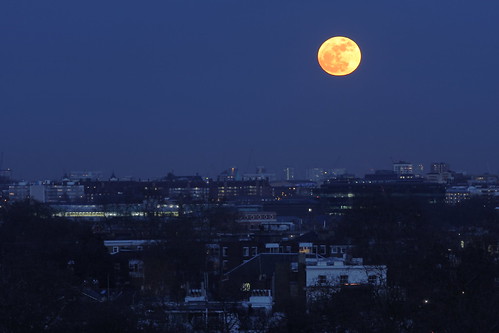
That’s when I spotted it through some trees: rising from whatever hiding place, a huge, humongous, startling moon! I didn’t think twice before changing my mind and my pathway and starting the climbing up the hill while not losing sight of that obscene moon – that’s how I immediately called it through my teeth: obscene!

Got up there and just marvelled at the spectacle of its wondrous rising, as more and more people, transfixed by it, came to the spot and its surroundings. Most had cameras, some of them potent, professional ones. I didn’t have any with me though.
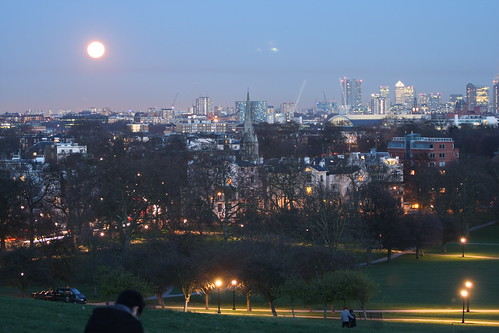
But in the last two days I managed to borrow these pictures from someone who got them from a couple of people who where there, at that same Primrose Hill spot, and saw exactly what I saw last Saturday: That Obscene Moon!


Monday, 14 February 2011
When Contemporary Art Goes to The Laundry... [Updated]*
... Or The Shape We're In!

This used to be one of our local launderettes. Then, be it because of the crisis or some other reason, at some point in the last few months it became just some sort of 'premises to let to whoever and for whatever' - the "happenings" there just keep changing all the time...

So, I wasn't supposed to be surprised at what just appeared there a couple of weeks ago... but... I was!
Covering the full front window, it just happened to us, everyday passers-by, this piece of contemporary art by Tracey Emin...
So, that's the shape we're in, I guess...

[*] Just found out some more about this "happening":
here, here and here.


Wednesday, 5 May 2010
UK: The return of Socialism?

Tomorrow is general election day here in the UK.
At the national level, although things are said to be still unpredictable, it looks like the Tories are about to reclaim power from Labour after more than a decade in opposition.
At the local level, I was pleased the other day to receive a visit by one of the local Councillors, the young Matt Sanders, whose first introduction to me was through the letter I commented on this post. We had a brief talk during which I assured him that “I quite like your team”…
Well, his team, the local Lib Dems, is headed by one Jo Shaw who is set against Frank Dobson (currently London’s longest-serving Labour MP and one of the “two prominent MPs” I referred to in the above-mentioned post) to represent this area in Westminster. I also quite like Frank Dobson, so I wish them both the best – which, unfortunately, in this case can only occur if both lose to some other candidate…
Then, there are the oddities. Like one John Chapman (could he be that other candidate?…) – Independent, 33 years a Whitehall civil servant and diplomat, 13 years a double award winning financial journalist – who has been campaigning “For a National Recovery and Redistribution Plan”!
His diagnostic of the UK economy:
The financial crisis has given us the biggest budget deficit in the West. Our government let in the culprits, notable the hedge funds, to boost the City. Disgracefully, the UK is now blocking an EU directive to regulate them.
The huge earnings of US speculators have led the City into bloated bonuses. Earnings of chief executives of our top 100 companies have risen to 81 times the average wage, from 47 times in 2000 (CBI).
The Thatcher years made us a most unequal society. In the USA incomes of the top fifth of people are 8.5 times those of the bottom fifth. In the UK, the ratio is 7.2, France 5.6, Germany 5.2, Sweden 3.8 and Japan 3.4 (UN). Social costs, from feelings of inadequacy to violent crime, rise with inequality.
Manufacturing’s share of our economy has fallen from 26% in 1979 to 12%. Companies are crippled by short-termism – City preference for dividends over investment. Our research & development as a proportion of GDP is now 30% below Germany, 40% below USA, and 50% below Japan (Batelle).
The NHS is under-funded. UK spend on health is 8.4% of GDP, below the 9.7% average of 15 West European countries. We have 2.5 doctors per 1000 people, the West European average is 50% higher at 3.7 per 1000 (OECD).
The pupil/teacher ratio of our state secondary schools is 15, the West European average is 11. Our private schools have a ratio of only 7 (OECD).
Our state pension is the lowest in Europe (Aon). But our military spend is higher than Russia. We invaded Iraq “largely for oil” (Alan Greenspan).
His Plan:
A huge Budget deficit. A discredited City. Weekened manufacturing. Under-resourced health, education and pensions. Doubtful wars. Alarming inequality.
The “efficient markets” model no longer works – because of unregulated financiers, and because “Across the world, the free market is being overtaken by state capitalism” (US Council on Foreign Relations), from China, Russia, the Middle East, and South American countries like Brazil and Venezuela.
We need a government of all parties to tackle our crisis, bolstered by industrialists, businessmen, union leaders, consultants and the professions.
We need a 5 year National Plan to rescue Britain and make it fairer. Indicative plans for each sector should be made coherent by a National Planning Department, replacing the failed Treasury. Merited taxes should also avoid savage expenditure cuts that shed jobs and reduce services.
Reforming the City A tax on banks, and a tax on the privileged hedge funds. A tax on dividends where companies have R&D below international levels.
Reducing Inequality A wealth tax of 2%, as in France and Switzerland. An excessive earnings tax, with earnings over £1m at 60%, over £2m at 75%. Inheritance tax at 60% for estates over £5m, and 75% for estates over £10m.
New state/private British companies to compete with state capitalism
State equity companies to strengthen private companies to help medium-seized companies grow into world players, to develop green technologies, to boost employment and the work ethic, and to revive the “Made in Britain” label.
Public expenditure and public services
More hospitals, more doctors and more teachers to match international levels. A levy on private schools for their disproportionate use of teaching resources. Higher state pensions for lowly paid to avoid means testing of their savings. Less military expenditure. Support nuclear cut-backs by no to Trident. Leave Afghanistan. More control over North Sea oil instead of further wars for oil.

Friday, 11 September 2009
Friday, 31 October 2008
SEU JORGE NA ROUNDHOUSE

Infelizmente, sai de la’ decepcionada. Na verdade, creio que foi a primeira vez que, tendo eu entrado para um espectaculo cheia de expectativas, a dada altura me aconteceu sentir-me alheada e momentaneamente assaltada por uma vontade de sair antes de ele ter terminado. Mas se me perguntarem se foi mau, ou “assim tao mau”, eu direi que nao, nao foi. De facto nao foi nada mau. Foi apenas aquem das minhas expectativas – de facto, estava mais do que expectante, estava convencida de que sairia de la’ satisfeita, a tal ponto que ate’ dispensei o ‘introito’ de Gilles Peterson que, quem sabe, talvez pudesse ter sido mais satisfatorio.
Refiro-me as cancoes que fazem parte do seu reportorio, porque reconheci, e de que maneira(!), as cancoes de uma mais que conhecida suite de musica carnavalesca (incluindo o "Mas Que Nada", "Mama Eu Quero", "Me Da’ Um Dinheiro Ai" e outras afins) com que ocupou o longo segmento final do show e que acabou por ser, pela participacao da audiencia, o seu momento mais alto. Ora, isso nao era exactamente o que eu esperava de um artista original e fora da mainstream, particularmente quando a audiencia, mesmo se largamente constituida por brasileiros residentes em Londres (que se reconheciam pela forma como dancavam, cantavam e gritavam durante todo o show), era em principio composta maioritariamente por pessoas que, como eu, mal o conheciam ou a sua musica. Enfim, em vespera de noite de Halloween foi como se tivesse sido presenteada com um misto de treat and trick, quando tudo o que esperava era o treat... Mas, adiante.
 Entretanto comprei o CD dele que la’ tinham a venda - "America, Brasil, O Disco" - e fui para casa esperando ressarcir-me de algum modo ouvindo-o. Gostei, achei-o musicalmente inovador e politicamente provocador, embora nao tenha encontrado nele algumas das cancoes que me lembro de ter ouvido durante o show, particularmente uma das poucas de que pude entender pelo menos uma frase que dizia “a carne mais barata do mercado e’ a carne negra”. Mas encontrei outras que ele tambem cantou e que achei interessantes, como “Trabalhador”, “Burguesinha” e “Mina do Condominio”.
Nao me lembro de ele ter cantado esta “So’ No Chat”, mas deixo-a aqui pelo muito que nos diz sobre as vidas virtuais que, mesmo sem disso muitas vezes nos apercebermos, cada vez mais vamos vivendo e, em muitos casos, com consequencias, se nem sempre desastrosas, pelo menos frequentemente pouco agradaveis e sempre caricatas ou, como tambem gosto de lhes chamar, irracionais…


Monday, 22 September 2008
'LINHA DE PASSE'
Ontem voltamos ao Odeon de Camden para ver esse filme brasileiro que se estreou aqui em Londres este fim de semana. Ja’ la’ nao ia, ou a qualquer outra sala de cinema, desde “The Last King of Scotland”. Mas, ao contrario daquela vez, nao foi necessario comprar os bilhetes com muita antecedencia e os espectadores presentes nao terao ocupado mais do que 1% da capacidade da sala.
Cada vez tenho menos paciencia para a boa meia hora, ou mais, de publicidade e ‘trailers’ antes do inicio do filme propriamente dito, mas ocupamo-la com ‘small talk’ sobre a tempestade que vai pela economia em geral e pelos mercados financeiros em particular, local e globalmente. Nao, o membro da tribo que trabalha na City de Londres, num dos maiores bancos britanicos (ainda) nao perdeu o emprego, apesar dos milhares de despedimentos que se teem verificado nas ultimas semanas no sector bancario e um pouco por toda a economia deste pais. Parece que o sistema financeiro global ainda esta’ a balancar no ‘fio da navalha’, ou na ‘linha de passe’, entre a profunda recessao e aquela coisa que os economistas bem avisados evitam pronunciar, pelo menos publicamente, porque parece ter o dom de se revelar uma ‘self-fulfilling prophecy’: a pura Depressao.
A este proposito, lembro-me que quando a crise se comecou a acentuar no ano passado, lutei aqui com o dilema de falar em “fears of a recession” ou “of a depression”, acabando por optar pela segunda por me parecer retratar melhor a realidade (sendo que na altura a maior parte dos observadores e analistas economicos hesitavam sequer falar em "recessao"). E, desde entao, a economia mundial nao tem feito outra coisa senao passar a linha entre a recessao e a depressao, que apenas nao se revela (ainda) tao profunda quanto a dos anos 30 devido ao desenvolvimento, entretanto, de mecanismos mais sofisticados de ‘salvamento’ dos sistemas financeiros e a actual globalizacao da economia, que permite, por exemplo, que investidores do Japao e do UK se aprestem rapidamente a adquirir partes do Lehman Brothers, que o FED Americano no seu papel actual de 'salva-vidas' nao pode impedir que se afundasse, entre tantos outros naufragos a atender com uma 'boia de salvacao' que avalia em cerca de USD 700 bi que parece nao saber ainda muito bem onde ir buscar... Economia global essa, onde neste momento apenas os maiores exportadores liquidos de petroleo, Angola incluida, parecem andar em bons espiritos...
 Mas, entretanto, o filme comecou e... nao acabou. E’, o filme nao teve fim, nao teve ‘the end’, nao teve ‘closure’ dos varios dramas sobre os quais se deteve. Ou melhor, teve-o, mas apenas implicitamente. O que talvez o tenha tornado mais interessante, mas tambem menos satisfatorio, pelo menos do meu ponto de vista, ou apenas da minha francamente ma’ disposicao de ontem (de facto, no regresso a casa acabei por ter que admitir que talvez me esteja a tornar rapidamente uma ‘grumpy old lady’...).
Enfim, pareceu-me mais um longo episodio de telenovela do que um filme propriamente dito, com varios ‘sketches’ a volta do quotidiano de uma familia composta por mae solteira, gravida de crianca de ‘pai desconhecido’, e seus quatro filhos de pais diferentes, nos arredores de Sao Paulo. Em linhas gerais, eu diria que e’ um filme sobre a ‘linha de passagem’ entre a pobreza absoluta e a relativa, entre a necessidade e a moralidade, entre a normalidade e a marginalidade, entre o sagrado e o profano e entre os sonhos possiveis e a realidade impossivel, com o futebol e as suas linhas de passe como ‘campo de fundo’. E sem ‘soundtrack’ (ou eu e’ que nao me dei conta dele?), o que tambem o torna interessante, mas tao cinzento quanto julgo ser Sao Paulo.
Sunday, 10 February 2008
CAMDEN MARKET UP IN FLAMES
Well, just parts of it, but sad and disturbing anyway. Trading continued as usual in not affected parts.
Perhaps an opportunity for planners and developers to start seriously rethinking the apparently uncontrollable mushrooming of shops and all sorts of vending outlets, particularly in the Stables' area.
Sunday, 16 December 2007
SUNDAY COVER & POETRY (VIII)

{GET CONTENT HERE}
{Poem: Sitting On The Pavement Outside The Camden Falcon, August 1987, by Alan Buckley. Alan was brought up in Merseyside and now lives in Oxford. He is currently one of two poets running the Live Literature Programme at HMP Grendon in Buckinghamshire - in Life Lines 2/Poets for Oxfam/Edited by Todd Swift, 2007}

Friday, 28 September 2007
CASSANDRA WILSON
 I slid my hand down her arm from shoulder to hand and she took it and shooked it and stayed… Hand in hand, there I was with Cassandra Wilson. For one of those seemingly long moments that stand for an eternity. This was when she came back from the stage downstairs after the main course. There she had just been giving me what I had come in for: to sort her out once and for all, to be bought into her sound for good, to let go the resistance to her moods that I’d been holding to for the last ten years, since I first heard and read about her, to finally get to taste that strange fruit that is her voice...
Scent of magnolia
sweet and fresh
Then the sudden smell
of burnin flesh
 There it was: a fruit as strange and as tasty as that of Lady Day, who first introduced me to that poem and song she made so hers. And she was in good company too: a sextet led by drummer Herlin Riley, with Reginald Veal on bass, Marvin Sewell on the guitars, Jason Moran on the piano and Lekan Babalola, a Nigerian whom she introduced as ‘African Royalty’, as the master percussionist. Riley (perhaps best known for his work with Wynton Marsalis and the Lincoln Center Jazz Orchestra) also got a special introduction, as ‘Sir’ – and, heavens, how he deserved it! I got the chance to tell him just that and how great he was while repeatedly ‘tapping’ with gusto on his shoulder. He paid me the compliment with an autograph with Love…
 That’s the thing about the Jazz Café, if you’re lucky enough, you can get an up-close and personal experience with the artists you come to see, while enjoying a nice meal if you happen to have booked a table upstairs in the restaurant – through which they happen to pass in their way to and from the stage. Initially we had been restless because the place was fully booked and we couldn’t get a view to the stage from the first table we got, but then got lucky enough to be moved (after the meal, which the music we were offered, specially Sewell’s spicy guitar sounds, made all taste like Cajun food straight from the bayous of New Orleans… By the way, in one of the very few occasions she addressed the audience she got us into the 'secret' of the right pronounciation of New Orleans...) to the best seats in the house – just upfront, overlooking the stage – from which we could enjoy the show as if we were right there in the stage as well… every single complicity movement and face expression composing that music body language which makes it live… and how we lived it… and played it! Specially the drums and percussion combinations by Riley and Babalola, wonderfully backed up by Veal.
 She might say as well as Miles used to: “just give me a good rhythm section and my ego is satisfied”… In the ego place where Miles had the trumpet, Cassandra has the voice – that clear, calm and steady, yet at times thunderous, deep and wondrous voice, with which, together with her earthy body movements, bare feet and closed eyes, she takes us from a calm beach to the depths of the ocean and back again on an irresistible tidal wave. And, like Miles, she offered us ‘Time after time’ as desert. On her final return from the stage she stopped by again to give me that much loved autograph – she had appreciated my ‘African ululus’, which she said had made the evening special (it was the last of an European Exclusive residency at the Jazz Cafe')… And then there were all the looks and sayings of how much we looked alike… but that’s another story.
Strange Fruit - Cassandra Wilson


Sunday, 5 August 2007


Thursday, 12 July 2007
THE DEMOCRACY & THE HUMANITY WITHIN
 With local elections where I live looming large, doorbells and mailboxes got extremely busy in the last few weeks – even exasperatingly so, at times.
But, today, something different from the usual electoral pamphlet came through my door: a hand-written letter from a local councillor asking for votes on her (much younger) supported candidate. Of course the letter was reproduced from the original and serially printed , but still it looked and felt like it was personally handwritten specially to each one of the addressees, just like the envelope was, not least because it ended with the word 'love'…
This got me to an often recurring reflection on the importance of the physical proximity and the personal touch in the relationship politician/electorate, particularly at the local level. Having heard and read so many times, especially from die-hard ‘marxists’ (although most of them have hardly ever read Marx, or practiced Marxism...) from my country of origin, rumblings about how Western democracy is all just about money and lobbying and the protection of the rich – in which they are often right when one looks at the higher echelons of political power in countries such as the US, or at scandals such as the “cash for honours” which has recently tarnished the Blair government – I find, however, something to be said for the “representative democracy” obtained through local elections.
 Just to give an example: some time ago, a gross mistake by my local council, while I was working abroad, had catastrophic consequences in my personal and professional life, including the loss of my home… Yet, through the local representation system, I could count with the personal availability, attention and services of two prominent MPs who have helped me to rectify, at least partially so far, the situation.
Just to put this into context: years ago, I lost, totally unlawfully, my house in Luanda. I wrote, cried and begged to everyone with any power or influence whatsoever to help me to recover it… to no avail, let alone a reply. As a result, I ended up staying where I could afford to have a home and my rights over it protected… that is London, at the moment.
These are the sort of “simple things of life" that make me value properly functioning institutions at all levels, accountable elected politicians and government officials, particularly at the local level, and the rule of law over the entire political and social system in any country.


Friday, 20 April 2007
JEAN-MICHEL BASQUIAT, OR… THOSE “SIX DEGREES OF SEPARATION”

There is that fine line between reality and fiction, truth and untruth, face and mask, genuine and fake, real and imagined which we all claim to know… and it seems to me that nowhere in life that line is more blurred than in art… fortunately, or unfortunately. In fact, there’s those ‘six degrees of separation’ which some claim to have we all in the planet at a short distance from each other through a chain of interconnections, but in reality always seem to keep us apart… as if at such a short distance we could all claim to ‘know’ each other, but never quite so… or maybe not! Whatever the case, I always think of these things when I think about Jean-Michel Basquiat. And, when I think about Basquiat, I always think of the strange, often devious, ways in which issues of identity, authenticity and the like are resolved, or unresolved, in (or through) art and in life in general…
“I cross out words so you will see them more – the fact that they are obscured makes you want to read them”
 "The History of Black People"


Monday, 19 February 2007
MY CAMDEN
But, just to put it in context, here’s what happenned a few months ago:
As widely reported, the ‘guerrilla’ graffiti artist Banksy has spray-painted a striking, large-scale image entitled 'Sweeping It Under The Carpet' on a wall in Chalk Farm, North London. According to the Independent, the work can be "seen as a metaphor for the West’s reluctance to tackle issues such as Aids in Africa." Banksy said that the piece was also about the democratisation of subjects in works of art: "In the bad old days, it was only popes and princes who had the money to pay for their portraits to be painted. This is a portrait of a maid called Leanne who cleaned my room in a Los Angeles motel. She was quite a feisty lady."

Then, the real go was for Charlie Brooker, in the Guardian (19/05/06), to have:
“Faced with a photo of a fly-encrusted child, the natural reaction should be to reach out and help. Instead, I start hearing Bono and Coldplay in my head. It's the most mind-mangling act of branding in history. I agree with what they are saying - I just wish THEY weren't saying it. How can I open my wallet while my fists are curled with rage? Take Bono's special edition of the Independent. It's incredibly annoying. You're trapped in a windowless room with the usual tedious sods who apparently represent British culture, except suddenly they're wearing halos and pulling earnest expressions at you.
The front cover is by Damien Hirst. He's lobbed some clipart together in the shape of a cross. Across this runs a stark headline: "NO NEWS TODAY". You jerk with astonishment. No news? How can this be? Help us Bono! We don't understand! Then you spot the footnote: "Just 6,500 Africans died today as a result of a preventable, treatable disease." You nod sadly. But before you can truly contemplate this harrowing injustice, you note that Damien Hirst's name appears on the cover not once, but twice - and suddenly the footnote takes on an even more tragic dimension. Because all those people died, yet Hirst still walks the Earth. You turn the page, weeping. Inside lurk about 2,000 adverts for the new Motorola RED phone. If you buy one, an Aids charity receives an initial payment of £10, followed by 5% of all further call revenues. This is clearly a good idea. But somehow, it's also annoying. For starters, the phone costs £149, of which £139 goes toward helping Motorola. Second, it's bright red and seems doomed to appeal to arseholes who want to add conspicuous compassion to their list of needless fashion accessories. I'm not just jabbering mindlessly on the phone in your train carriage - I'm saving fuckin' lives, OK?

Page 11: a piece of artwork by renegade graffiti artist Banksy, who has defaced a wall in Chalk Farm with a picture of a hotel maid. It's called Sweeping It Under the Carpet and "can be seen as a metaphor for the west's reluctance to tackle issues such as Aids in Africa" - or another example of Banksy's tireless self-promotion; take your pick. Banksy says the maid in question "cleaned my room in a Los Angeles motel ... she was quite a feisty lady". Presumably his next portrait will depict some poor minimum-wage sod, cleaning graffiti off a wall in Chalk Farm. Provided they're "feisty" enough to appeal to him.
On it goes, with one Bonoriffic chum after another: noted philanthropist Condoleezza Rice picks her top 10 tunes (including one by U2); Stella McCartney interviews Giorgio Armani, who has designed a pair of sunglasses for the RED charity range. These cost around £72 and will make you look like Bono: buy a 10 quid pair from Boots, bung the remaining £62 to an Aids charity and not only will you enjoy a warm philanthropic glow, no one's going to shout "wanker!" at you when you walk down the high street.
In summary: it's a worthy cause, rendered annoying - and that's annoying in itself. Bono genuinely cares, cares enough to risk ridicule, which is more than most people would do, myself included. It's just that, well it's bloody Bono, isn't it?”

Well… what can I say? Apart from the fact that I really enjoyed all the fuss made about it in the papers, not just the Indy’s and Guardian’s but our own Camden New Journal and Camden Gazzette, that is. I'm just a legal alien in London who happens to love her Camden - the Market, the Lock, the Canal, the Jazz Cafe', Primrose Hill, Belzise Park, the Northern Line, the Zoo, the parts of Regent's Park, Bloomsbury, Finchley Road, Tottenham Court Road, Marylebone, St. John's Wood and Swiss Cottage that are rightfully ours (and don't you ever, ever dare to call us "imperialists"... after all, this is where "Red Ken" got most of the votes that put him where he is!), Hampstead Heat, Highgate Village, the Royal Free, Kentish Town, King's Cross, Euston, Chalk Farm, the brand new Roundhouse and Banksy’s maid included... And... yes, the graffitti is still there 9 months on... from time to time someone 'graffittis' upon it, but someone else, maybe some poor minimum-wage sod (or Banksy himself; take your pick), cleans it off... Cheers!
Photos: my own.


Monday, 12 February 2007
"THE LAST KING OF SCOTLAND"


Ja’ vi melhores filmes sobre Africa e os Africanos, ja’ vi melhores filmes sobre a politica, a ditadura e os ditadores em Africa, ja’ vi melhores filmes sobre as relacoes amorosas, ou simplesmente sexuais, entre Europeus e Africanas… mas nao vi filmes muito melhores sobre a relacao entre dois seres humanos de caracteristicas tao diametralmente opostas, sob todos os pontos de vista, como a relacao entre Idi Amin (Forest Whitaker) e o seu “medico e conselheiro privado”, Nicholas Garrigan (James McAvoy), embora baseada numa estoria completamente ficcionada. Relacao ainda mais valorizada pelas eximias representacoes dos dois actores.

E apenas isso, quanto a mim, impede que ”The Last King of Scotland” resvale para a longa serie de filmes sobre Africa que pouco mais conseguem ser do que colagens, mais ou menos bem conseguidas cinematograficamente, de cliches e estereotipos baseados em personagens ou episodios historicos. Isso e o facto de, tendo visitado o Uganda ha cerca de um ano atras, visita durante a qual fiz uma longa viagem de autocarro pelo interior do pais, ter reconhecido nas paisagens e habitats naturais, humanos e animais mostrados no filme (incluindo a enorme “ave de rapina”, cujo nome desconheco, que vi, repetidamente em varios locais, pela primeira e unica vez no Uganda), o “pais real” retratado, o que e’ sempre reconfortante perante a quantidade de filmes sobre pais A filmados em pais B, ou estudio C, quantas vezes em continentes completamente diferentes.
De volta a casa, a noticia: Forest Whitaker tinha acabado de ganhar o Bafta para melhor actor do ano, o que o coloca numa posicao mais proxima de concretizar a expectativa assim expressa ha' dias por um apresentador da ex-Jazz FM (agora ‘downgraded’ para Smooth FM, mas que continua a ser a minha radio preferida, a excepcao das Quartas e Sabados quando vira uma radio quase exclusivamente de futebol e com relatos quase exclusivamente dos jogos do Chelsea…): “if there’s any justice in the world, which rarely is, Whitaker should win the Oscar”. Com ele no podium de ‘bests’, a minha favorita British Dame, Helen Mirren, que ganhou o Bafta para melhor actriz pela sua representacao de Elizabeth II em “The Queen”. Parecem estar encontrados, merecidamente, o Rei e a Rainha dos Oscars deste ano…

Curiosamente, hoje Shilpa voltou as primeiras paginas dos tabloides Londrinos depois de alguns dias de ausencia, desta vez ela propria acusada de racismo por ter apresentado e participado num ‘sketch’ do seu show numa cadeia televisiva Indiana que recriava os “minstreis” (actores pintados de preto dizendo piadas supostamente hilariantes, mas consideradas profundamente ofensivas pelas comunidades negras). Ora, este tipo de shows e imagens (tradicionalmente parte dos tristemente celebres “Minstrel Shows” no Ocidente) foram banidos da TV Britanica em 1978, depois de grandes controversias e manifestacoes de repudio no UK, por finalmente terem sido oficialmente classificados como “obscenamente racistas”… O que me leva de volta ao “Last King of Scotland” porque nao pude deixar de reparar na quantidade de ‘black make-up’ que lhe foi aplicado para tornar Whitaker tao “preto” como Idi Amin… O que me transporta a um outro filme que vale a pena ver: “Bamboozled”, de Spike Lee, uma brilhante satira sobre os “Minstrel Shows” nos EUA.

P.S.: O “Grazing in the Grass” do Bra Masekela pareceu-me um pouco deslocado no filme, mas como boa musica vai sempre bem com quaisquer imagens, soube-me bem ouvi-lo.
