Showing posts with label LVO. Show all posts

Sunday, 13 April 2008

LOCAL VOICES OFFLINE (12)

Things someone, somewhere in the world, was talking about but you probably weren’t listening…


Free file hosting by Ripway.com


Compras

Obs: There were interesting developments since my two previous takes on this series on Cuba, where the restrictions on access by Cubans to cellphones and tourist hotels were raised: both restrictions have been lifted!

Things someone, somewhere in the world, was talking about but you probably weren’t listening…


Free file hosting by Ripway.com


Compras

Obs: There were interesting developments since my two previous takes on this series on Cuba, where the restrictions on access by Cubans to cellphones and tourist hotels were raised: both restrictions have been lifted!

Sunday, 30 March 2008

LOCAL VOICES OFFLINE (11)

Things someone, somewhere in the world, was talking about but you probably weren’t listening…


Free file hosting by Ripway.com


Chopper for the Vice President


[Obs: President Mogae is expected to officially step down tomorrow in favour of Vice-President Ian Khama. Read more HERE]

Things someone, somewhere in the world, was talking about but you probably weren’t listening…


Free file hosting by Ripway.com


Chopper for the Vice President


[Obs: President Mogae is expected to officially step down tomorrow in favour of Vice-President Ian Khama. Read more HERE]

Saturday, 29 March 2008

Sunday, 16 March 2008

LOCAL VOICES OFFLINE (10)

Things someone, somewhere in the world, was talking about but you probably weren’t listening…


Free file hosting by Ripway.com


Cuba: Celulares

Obs:There were news this week that the sale of a number of electronic devices has finally been officially authorised in Cuba, but I'm not sure if cellphones are included...

Things someone, somewhere in the world, was talking about but you probably weren’t listening…


Free file hosting by Ripway.com


Cuba: Celulares

Obs:There were news this week that the sale of a number of electronic devices has finally been officially authorised in Cuba, but I'm not sure if cellphones are included...

Sunday, 9 March 2008

LOCAL VOICES OFFLINE (9)

Things someone, somewhere in the world, was talking about but you probably weren’t listening…


Both protagonists of the story behind this speech made the news headlines this week in the UK. Francis Pym passed away this Friday, aged 86. On the same day, Mrs. (now Lady) Thatcher, aged 82, spent a night in hospital for ill health.
As we just celebrated International Women’s Day, a question springs to mind: was the Iron Lady ever taken as an icon by any female gender activist around the world?

FRANCIS PYM was pitchforked into the post of Foreign Secretary during the Falklands crisis. During the election he expressed some doubts about the value of large majorities; and when the Tories won with the largest majority they’d ever had, he was sacked by Mrs. Thatcher. His departure was leaked, probably by Number Ten. Speaking as a backbencher for the first time for 21 years, he did not disguise how much it hurt. He warned Mrs. Thatcher to tackle unemployment and unite the people. (29/6/83)
Things someone, somewhere in the world, was talking about but you probably weren’t listening…


Both protagonists of the story behind this speech made the news headlines this week in the UK. Francis Pym passed away this Friday, aged 86. On the same day, Mrs. (now Lady) Thatcher, aged 82, spent a night in hospital for ill health.
As we just celebrated International Women’s Day, a question springs to mind: was the Iron Lady ever taken as an icon by any female gender activist around the world?

FRANCIS PYM was pitchforked into the post of Foreign Secretary during the Falklands crisis. During the election he expressed some doubts about the value of large majorities; and when the Tories won with the largest majority they’d ever had, he was sacked by Mrs. Thatcher. His departure was leaked, probably by Number Ten. Speaking as a backbencher for the first time for 21 years, he did not disguise how much it hurt. He warned Mrs. Thatcher to tackle unemployment and unite the people. (29/6/83)

Sunday, 24 February 2008

LOCAL VOICES OFFLINE (8)

Things someone, somewhere in the world, was talking about but you probably weren’t listening…


Free file hosting by Ripway.com


THE GREAT SHE-ELEPHANT


The row over GCHQ (Government Communications Headquarters) led to a full-scale, angry debate in the Commons, in which the Shadow Foreign Secretary, DENIS HEALEY, gave one of his best performances, attacking Mrs. Thatcher as the real author of the change, pulling Sir Geoffrey’s strings. He said Sir Geoffrey had made himself the laughing stock of the world, and that he had kicked constructive Trade Union leaders in the teeth. (27/2/84)


Things someone, somewhere in the world, was talking about but you probably weren’t listening…


Free file hosting by Ripway.com


THE GREAT SHE-ELEPHANT


The row over GCHQ (Government Communications Headquarters) led to a full-scale, angry debate in the Commons, in which the Shadow Foreign Secretary, DENIS HEALEY, gave one of his best performances, attacking Mrs. Thatcher as the real author of the change, pulling Sir Geoffrey’s strings. He said Sir Geoffrey had made himself the laughing stock of the world, and that he had kicked constructive Trade Union leaders in the teeth. (27/2/84)


Saturday, 23 February 2008

INTERROGATING THE BLOGOSPHERE (III)


I swear to anyone remotely interested in this: there’s nothing I would like more at the moment than a quiet and relaxed weekend, or anything I could have wished more than a safe and trouble-free journey in the blogosphere, throughout the rest of this year, particularly taking into account what I went through all last year…

But, as I was waiting to see my reply to a comment I found on GVO (reproduced here) appear there, I just took a look at that site again and found this thing.

Now, as I was
talking here about “objectivity/subjectivity”, with Sokari, there were always at least two words on the back of my mind I felt were missing in our conversation, and those were “bias” and “manipulation” (of opinion)!
Now, why would it be that the selected paragraph from that article would be the one appeared on GVO and not any of these:

“O Brasil é dos países mais ricos e diversos culturalmente que já vi, e ao mesmo tempo o pais mais racista que já vi. Angola é dos países mais ricos e diversificados que África possui e ainda assim sofre severamente de racismo. Os critérios de entrada na discoteca, são dos que mais gosto para exemplificar os estereótipos, mesmo porque já fui vitima deste exemplo varias vezes. Os estrangeiros(brancos/mulatos) têm dinheiro.”

“Motivos por ser um pais racista? São dos mais diversos, sendo a colonização para mim o "motivo base" do racismo em Angola, e em todos países do Mundo. Todos países do mundo? Sim, todos os países do mundo! A colonização não resultou só na exploração e ocupação de um povo, mas também resultou na "migração" desse povo durante anos e anos. Os que foram ocupados e explorados fora misturados como é o caso de Angola. Misturados coisa que não aconteceu muitos com os outros países colonizadores, sendo Portugal o mais "mente aberta" quando se tratava de "conhecer" melhor o povo ocupado. E os que colonizavam e que são muitos deles conhecidos como países do primeiro mundo hoje em dia, não estavam contentes por terem sobre sua guarda os povos explorados, portanto resolveram começar a "trazê-los" para os seus países "super-desenvolvidos" onde o ser humano não era um "selvagem",mas sim um "civilizado". Isto tudo mesmo com o fim da escravatura e da colonização deixou marcas e vestígios enormes na nossa sociedade.”

“Hum..e já me esquecia, a resposta que eu dei a senhora que tratava do bilhete foi : EU SOU ANGOLANO!! e ela deu-me um bom xoxo à moda da terra e escreveu RACA: MISTA. Paz,”

Of course, 'simple-minded' people would say: well, because the “editor” didn’t even had the time to read the full article, let alone “think about it”, so she just copied and pasted the first paragraph of ... well, the last part of the article, why should it be the first?

And why did she select that particular article and not, say, this one? Or this one, or the clip on this one? Or the comments on this one?
Well, my dear, the 'simpleton' would say, because she has far more interesting things to do, don't you think?”

Sorry, English readers only, but if you want a translation of the excerpts I transcribed here, or of the full article in question, you may wish to ask the Portuguese-language team at GVO for it (I’m sorry, but I am not paid for that, never have been, and I’m not sure the same can be said about them…), or use the available online translation devices if you please.*

Enjoy your weekend anyway!

***

*P.S.: I might just add, for the benefit of a better understanding of this issue, that the claim that the mention of ‘races’ in Angolan identity cards (as in here, where mine is pictured) is "an act of racism against them” is a pet cause of the white and mixed-race minorities in the country (as is, by the way, their hatred for the figure of Queen Nzinga Mbandi – whose picture I’m currently using as this blog’s logo – and for her statue in one of the two main squares in the capital city, Luanda).
As with any rule, there are, of course, exceptions, as exemplified by a recent statement by the widow of the first Angolan President (here) who says that “some people get very offended by that, but I am not sure that it is an offense.”

I swear to anyone remotely interested in this: there’s nothing I would like more at the moment than a quiet and relaxed weekend, or anything I could have wished more than a safe and trouble-free journey in the blogosphere, throughout the rest of this year, particularly taking into account what I went through all last year…

But, as I was waiting to see my reply to a comment I found on GVO (reproduced here) appear there, I just took a look at that site again and found this thing.

Now, as I was
talking here about “objectivity/subjectivity”, with Sokari, there were always at least two words on the back of my mind I felt were missing in our conversation, and those were “bias” and “manipulation” (of opinion)!
Now, why would it be that the selected paragraph from that article would be the one appeared on GVO and not any of these:

“O Brasil é dos países mais ricos e diversos culturalmente que já vi, e ao mesmo tempo o pais mais racista que já vi. Angola é dos países mais ricos e diversificados que África possui e ainda assim sofre severamente de racismo. Os critérios de entrada na discoteca, são dos que mais gosto para exemplificar os estereótipos, mesmo porque já fui vitima deste exemplo varias vezes. Os estrangeiros(brancos/mulatos) têm dinheiro.”

“Motivos por ser um pais racista? São dos mais diversos, sendo a colonização para mim o "motivo base" do racismo em Angola, e em todos países do Mundo. Todos países do mundo? Sim, todos os países do mundo! A colonização não resultou só na exploração e ocupação de um povo, mas também resultou na "migração" desse povo durante anos e anos. Os que foram ocupados e explorados fora misturados como é o caso de Angola. Misturados coisa que não aconteceu muitos com os outros países colonizadores, sendo Portugal o mais "mente aberta" quando se tratava de "conhecer" melhor o povo ocupado. E os que colonizavam e que são muitos deles conhecidos como países do primeiro mundo hoje em dia, não estavam contentes por terem sobre sua guarda os povos explorados, portanto resolveram começar a "trazê-los" para os seus países "super-desenvolvidos" onde o ser humano não era um "selvagem",mas sim um "civilizado". Isto tudo mesmo com o fim da escravatura e da colonização deixou marcas e vestígios enormes na nossa sociedade.”

“Hum..e já me esquecia, a resposta que eu dei a senhora que tratava do bilhete foi : EU SOU ANGOLANO!! e ela deu-me um bom xoxo à moda da terra e escreveu RACA: MISTA. Paz,”

Of course, 'simple-minded' people would say: well, because the “editor” didn’t even had the time to read the full article, let alone “think about it”, so she just copied and pasted the first paragraph of ... well, the last part of the article, why should it be the first?

And why did she select that particular article and not, say, this one? Or this one, or the clip on this one? Or the comments on this one?
Well, my dear, the 'simpleton' would say, because she has far more interesting things to do, don't you think?”

Sorry, English readers only, but if you want a translation of the excerpts I transcribed here, or of the full article in question, you may wish to ask the Portuguese-language team at GVO for it (I’m sorry, but I am not paid for that, never have been, and I’m not sure the same can be said about them…), or use the available online translation devices if you please.*

Enjoy your weekend anyway!

***

*P.S.: I might just add, for the benefit of a better understanding of this issue, that the claim that the mention of ‘races’ in Angolan identity cards (as in here, where mine is pictured) is "an act of racism against them” is a pet cause of the white and mixed-race minorities in the country (as is, by the way, their hatred for the figure of Queen Nzinga Mbandi – whose picture I’m currently using as this blog’s logo – and for her statue in one of the two main squares in the capital city, Luanda).
As with any rule, there are, of course, exceptions, as exemplified by a recent statement by the widow of the first Angolan President (here) who says that “some people get very offended by that, but I am not sure that it is an offense.”

Sunday, 17 February 2008

LOCAL VOICES OFFLINE (7)

Things someone, somewhere in the world, was talking about but you probably weren’t listening…


Free file hosting by Ripway.com


Where is My Citizenship


N.B.: Only recently has the Government of Botswana started to relax the law requiring applicants for citizenship in the country to be fluent in Setswana.
Things someone, somewhere in the world, was talking about but you probably weren’t listening…


Free file hosting by Ripway.com


Where is My Citizenship


N.B.: Only recently has the Government of Botswana started to relax the law requiring applicants for citizenship in the country to be fluent in Setswana.

Tuesday, 12 February 2008

INTERROGATING THE BLOGOSPHERE (II)

In the previous post, I raised, among others, the following questions:

Firstly, what is exactly the “mainstream media”? Does it include the same type of outlets in New York, Lisbon, Luanda, Boston, Porto, Brazilia, Maputo, London, Praia, Vila Nova de Gaia, Rio, Lubango or Dili? Secondly, to what extent can a blogger based in Portugal, USA, UK or Cabo Verde accurately reflect the voices of communities and individual citizens in N’Dalatando, Quelimane or Principe, whose concerns might not be heard online? Can such a blogger in any case reflect them better than another one based closer to those communities, unless he visits them regularly or has close family, friendship, or professional ties with them? Thirdly, who gets to determine, and under whose criteria, which are “the most interesting conversations and perspectives emerging from citizens’ media around the world”, as per the GVO “Primary Goals”?

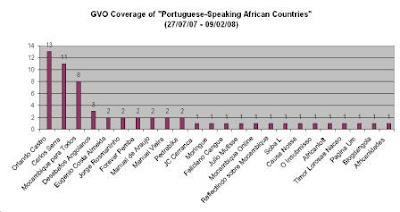
Trying to find some answers, I took a close look at the GVO coverage of “Portuguese-speaking African countries” in the last six months*:

The most striking observation from this graph is that OC appears not only, as we have seen before, as the “undisputed champion” of GVO reporting about the “Angolan blogosphere”, but also as the “champion” (only “disputed” by Carlos Serra, one of the bloggers I covered for GVO) of their “Lusophone” Sub-Saharan Africa reporting. A second interesting observation is that less than one third of the bloggers covered are actually based in Sub-Saharan Africa.

Another, not less interesting, observation is that we get, just to give an example, issues and events about Angola or Sao Tome & Principe covered by East-Timorese or Portuguese blogs – which perhaps shouldn’t come as a surprise considering that some of these blogs are, to put it mildly, “highly influenced” (at least judging from the prominence of his picture on them) by none other than OC, who also appears as the presumable overseer of a “blog production line” (Fabrica de Blogues) spreading from Portugal to Timor. It’s also interesting to observe how OC manages to appear in the coverage of an event in Mozambique, which was being thoroughly covered by Mozambican bloggers in situ.

At first sight, one might be tempted to conclude that these trends reflect a lack of diversity of African-based blogs written in Portuguese. However, as it can be gathered from
this list (where, incidentally, my blog doesn’t figure and, by their own admission, is “manipulated” by… exactly, OC), or from this one (where my blog is also not listed) that is not the case.

It is abundantly clear that the GVO “Portuguese-speaking Africa” editorial line is inspired by the concept of “lusofonia”. However, this raises a number of issues, starting with this: just imagine that you are a South African blogger systematically seeing events happening at your doorstep, and that you also blogged about, reported at GVO by British, Nigerian or American bloggers simply because they too are English-speaking and read about it in the conventional mainstream media, or in your own blog? Or that you are a Maurician or Malgache Creole-speaking citizen who finds your local issues covered at GVO by Gabonese, Algerian or Haitian bloggers, in French, just because their countries are also former French colonies? And this kind of examples could go on and on.

But perhaps the most problematic implication of that approach is that the concept of “lusofonia” itself is a highly contentious one and is far from reuniting consensus in all countries involved – not least because, on the one end, the majority of the African populations in those countries are primarily speakers of their own national languages and, on the other, the concept is highly reminiscent of the Portuguese colonial state’s imperial ideology, according to which there was a single “cultural unit” from Minho (extreme North of Portugal) to Timor - as reflected by the spread of the "OC blogging empire"...

The controversy generated by that approach can be gathered, for instance, from this article by a Mozambican professor of African Literatures at a Portuguese University, or from an article by a Brazilian writer and senior government official, whose link can be found on this post, or from another article by the Mozambican author Joao Craveirinha, whose link can be found on this post. However, these ponderous critical perspectives are unceremoniously dismissed as “gritaria” by the Portuguese language editorial team at GVO, which happens to be exclusively integrated by Brazilian citizens.

Now, on the question of who gets to determine, and under whose criteria, which are “the most interesting conversations and perspectives emerging from citizens’ media around the world”, as per the GVO “Primary Goals”?, let’s just look at some examples taken at random:

- How is it decided that
this criticism of the publication for the first time in the Portuguese market of a magazine directed at African women is “more interesting” than, say, the criticisms arising from this, or this?

- How is it decided that
this treatment of the “Miss Landmine Angola Pageant” is “more interesting” than, say, this one?

- How is it decided that
this presentation of an Angolan music/dance genre is “more interesting” than, say, this one (where the main message is that “Angola is good for everybody except for Angolans”), or any of these (where the rising voices and social consciousness of a new generation of Angolan musicians appear loud and clear)?

- How is it decided that
this tribute to Ian Smith is “more interesting”, than, say, something like this?

- How is it decided that this anonymous email message is credible and "more interesting" than any other possible account of the reality on the ground, such as these, or any of these?

- How is it decided that this account of the EU-Africa Summit is "more interesting than, say, this one?

- How is it decided that an event like this “is not interesting”?

Finally, how can GVO’s “loud silence” about
this event be explained? The same GVO whose mission includes things like, “shining light on places and people other media often ignore (…) to make sense of it all, and to highlight things that bloggers are saying which mainstream media may not be reporting (…) to help people speak out in places where powerful forces would prevent them from doing so (…) and to enable more people whose voices and views are not heard to speak out online.”
The same GVO where articles like this, for example, can be read?

*N.B.: To be accurate, in all 6 instances where my blog appears on GVO links during the period under analysis, it was not on the initiative of the Portuguese-language editorial team. So, they shouldn't be included in this graph because, for all intents and purposes, this blog was excluded from their reporting in the last six months.
In the previous post, I raised, among others, the following questions:

Firstly, what is exactly the “mainstream media”? Does it include the same type of outlets in New York, Lisbon, Luanda, Boston, Porto, Brazilia, Maputo, London, Praia, Vila Nova de Gaia, Rio, Lubango or Dili? Secondly, to what extent can a blogger based in Portugal, USA, UK or Cabo Verde accurately reflect the voices of communities and individual citizens in N’Dalatando, Quelimane or Principe, whose concerns might not be heard online? Can such a blogger in any case reflect them better than another one based closer to those communities, unless he visits them regularly or has close family, friendship, or professional ties with them? Thirdly, who gets to determine, and under whose criteria, which are “the most interesting conversations and perspectives emerging from citizens’ media around the world”, as per the GVO “Primary Goals”?

Trying to find some answers, I took a close look at the GVO coverage of “Portuguese-speaking African countries” in the last six months*:

The most striking observation from this graph is that OC appears not only, as we have seen before, as the “undisputed champion” of GVO reporting about the “Angolan blogosphere”, but also as the “champion” (only “disputed” by Carlos Serra, one of the bloggers I covered for GVO) of their “Lusophone” Sub-Saharan Africa reporting. A second interesting observation is that less than one third of the bloggers covered are actually based in Sub-Saharan Africa.

Another, not less interesting, observation is that we get, just to give an example, issues and events about Angola or Sao Tome & Principe covered by East-Timorese or Portuguese blogs – which perhaps shouldn’t come as a surprise considering that some of these blogs are, to put it mildly, “highly influenced” (at least judging from the prominence of his picture on them) by none other than OC, who also appears as the presumable overseer of a “blog production line” (Fabrica de Blogues) spreading from Portugal to Timor. It’s also interesting to observe how OC manages to appear in the coverage of an event in Mozambique, which was being thoroughly covered by Mozambican bloggers in situ.

At first sight, one might be tempted to conclude that these trends reflect a lack of diversity of African-based blogs written in Portuguese. However, as it can be gathered from
this list (where, incidentally, my blog doesn’t figure and, by their own admission, is “manipulated” by… exactly, OC), or from this one (where my blog is also not listed) that is not the case.

It is abundantly clear that the GVO “Portuguese-speaking Africa” editorial line is inspired by the concept of “lusofonia”. However, this raises a number of issues, starting with this: just imagine that you are a South African blogger systematically seeing events happening at your doorstep, and that you also blogged about, reported at GVO by British, Nigerian or American bloggers simply because they too are English-speaking and read about it in the conventional mainstream media, or in your own blog? Or that you are a Maurician or Malgache Creole-speaking citizen who finds your local issues covered at GVO by Gabonese, Algerian or Haitian bloggers, in French, just because their countries are also former French colonies? And this kind of examples could go on and on.

But perhaps the most problematic implication of that approach is that the concept of “lusofonia” itself is a highly contentious one and is far from reuniting consensus in all countries involved – not least because, on the one end, the majority of the African populations in those countries are primarily speakers of their own national languages and, on the other, the concept is highly reminiscent of the Portuguese colonial state’s imperial ideology, according to which there was a single “cultural unit” from Minho (extreme North of Portugal) to Timor - as reflected by the spread of the "OC blogging empire"...

The controversy generated by that approach can be gathered, for instance, from this article by a Mozambican professor of African Literatures at a Portuguese University, or from an article by a Brazilian writer and senior government official, whose link can be found on this post, or from another article by the Mozambican author Joao Craveirinha, whose link can be found on this post. However, these ponderous critical perspectives are unceremoniously dismissed as “gritaria” by the Portuguese language editorial team at GVO, which happens to be exclusively integrated by Brazilian citizens.

Now, on the question of who gets to determine, and under whose criteria, which are “the most interesting conversations and perspectives emerging from citizens’ media around the world”, as per the GVO “Primary Goals”?, let’s just look at some examples taken at random:

- How is it decided that
this criticism of the publication for the first time in the Portuguese market of a magazine directed at African women is “more interesting” than, say, the criticisms arising from this, or this?

- How is it decided that
this treatment of the “Miss Landmine Angola Pageant” is “more interesting” than, say, this one?

- How is it decided that
this presentation of an Angolan music/dance genre is “more interesting” than, say, this one (where the main message is that “Angola is good for everybody except for Angolans”), or any of these (where the rising voices and social consciousness of a new generation of Angolan musicians appear loud and clear)?

- How is it decided that
this tribute to Ian Smith is “more interesting”, than, say, something like this?

- How is it decided that this anonymous email message is credible and "more interesting" than any other possible account of the reality on the ground, such as these, or any of these?

- How is it decided that this account of the EU-Africa Summit is "more interesting than, say, this one?

- How is it decided that an event like this “is not interesting”?

Finally, how can GVO’s “loud silence” about
this event be explained? The same GVO whose mission includes things like, “shining light on places and people other media often ignore (…) to make sense of it all, and to highlight things that bloggers are saying which mainstream media may not be reporting (…) to help people speak out in places where powerful forces would prevent them from doing so (…) and to enable more people whose voices and views are not heard to speak out online.”
The same GVO where articles like this, for example, can be read?

*N.B.: To be accurate, in all 6 instances where my blog appears on GVO links during the period under analysis, it was not on the initiative of the Portuguese-language editorial team. So, they shouldn't be included in this graph because, for all intents and purposes, this blog was excluded from their reporting in the last six months.

Sunday, 10 February 2008

INTERROGATING THE BLOGOSPHERE (I)


Six months have passed since my last post in what turned out to be a very brief voluntary collaboration with GVO. So, I saw it fit to initiate this series of reflections on my life in the blogosphere so far with that experience.

When I started this journey in the blogosphere just over a year ago, I knew virtually nothing about it. I had accidentally come across one or two blogs before and that was it. So, when I was invited by the Sub-Saharan Africa editor of GVO to collaborate with them, covering the "Portuguese-speaking African countries", it took me a while to accept it but I eventually decided to take on the challenge – and how I knew from the beginning how much of a challenge it would be! I took it mainly as an opportunity to, as I gradually got to know the “lusosphere”, report about it, in English, to the global online community. So, to me it was all about “juntar o util ao agradavel”.

I set out without any particular agenda whatsoever, if not just because I didn’t know at all what I was about to find. But I had a very clear idea, guided by the GVO Manifesto and Mission Statement, that my work would be aimed at “shining light on places and people other media often ignore (…) to make sense of it all, and to highlight things that bloggers are saying which mainstream media may not be reporting (…) to help people speak out in places where powerful forces would prevent them from doing so (…) and to enable more people whose voices and views are not heard to speak out online.”

Well, I may have arrived at the blogosphere as naïve as a nun straight out of a convent, but I was (am) all but naïve about the real world. A real world where I have seen so many organisations, projects and people theoretically motivated by some of the most noble of principles, aims and objectives but, given the opportunities created by lack of transparency and accountability, the pursuit of individual agendas, or other factors such as ignorance, short-sightedness, personal insecurities and lack of professionalism, in practice easily turn into arrogant, megalomaniac, insensitive monsters practicing the exact opposite of what they claim to profess.

More to the point: even though, at the start of my “mission” with GVO, I had gone through a very rough path of conflicts with pornographic, racist and extreme-right sectors of the “lusosphere” who seemed not to have any other purpose in life than to attempt by all means necessary to harass me and tarnish my reputation in the blogosphere, both in mine and other blogs, I had no intention of, on my reporting for GVO, sidelining anyone who might have sided with them, by words, deeds or omissions, provided that their blog posts met the GVO principles and objectives – and this much I clearly stated in the introduction to my first post for GVO.

So, I started with a blog based in Portugal through which the global world, using its comprehensive blogroll, could access virtually the entire “lusosphere”. Thereafter, my main concern was to give utmost priority to bloggers based in the countries I was supposed to cover. This led me to follow up my reporting with the first blog I found in the Mozambican blogosphere, and then with one of the few blogs reporting from inside Angola. My reporting took the form of “bloggers profiles” mainly because of the relatively fewer number of blogs in those countries and their geographical and thematic dispersion. In my choices, there were no considerations of race, gender, politico-ideological orientation or any other subjective factors. There was, however, a clear concern with whether the issues they were blogging about were of the kind that may not be reported by the mainstream media, either in the respective countries or abroad.

And this is where things got complicated. Firstly, what is exactly the “mainstream media”? Does it include the same type of outlets in New York, Lisbon, Luanda, Boston, Porto, Brazilia, Maputo, London, Praia, Vila Nova de Gaia, Rio, Lubango or Dili? Secondly, to what extent can a blogger based in Portugal, USA, UK or Cabo Verde accurately reflect the voices of communities and individual citizens in N’Dalatando, Quelimane or Principe, whose concerns might not be heard online? Can such a blogger in any case reflect them better than another one based closer to those communities, unless he visits them regularly or has close family, friendship, or professional ties with them? Thirdly, who gets to determine, and under whose criteria, which are “the most interesting conversations and perspectives emerging from citizens’ media around the world”, as per the GVO “Primary Goals”?

Before attempting to answer any of these questions, let me talk about the reactions to my third, and eventually last, post for GVO. It was attacked, or rather, I was attacked because of it, on that blog by a group of lusophone bloggers led by one certain Orlando Castro (OC) and including the first blogger I had covered for GVO, on the absolutely groundless and personally insulting libel that “unlike the author of that blog, I had fled Angola without thinking!” Well, this is someone I don’t know and doesn’t know me personally apart from the blogosphere (the same applying to all the bloggers I’ve come across so far) and with whom, I must stress, I never had exchanged any comments or dialogues, directly or indirectly (in fact, I only got to properly know his blog after taking that blow on the stomach from him completely out of the blue) and I might even, as I went on with my work, if allowed to, at some point cover his and his group’s blogs.

The origin of that totally unprovoked and absurd libellous attack about my alleged “flight” from Angola, with or without thinking, is well determined in the “lusosphere”, as are the motivations of its author, and I had it thrown at my face before by the people who have been keeping me under siege in the blogosphere and have forced me to temporarily restrict access to my blog and implement comment moderation on it (costing me a considerable number of visitors, commentators, friends and contributors) and also forced me to get an interview I had given to the blog Szavanna about Angolan music withdrawn.
However, to this day I struggle to understand what led OC to come up with it at that particular blog I covered for GVO. “Is it because I is black?”, as Ali G would ask, or was it because, unlike the previous two bloggers I had covered, the owner of that blog happens to be black? Or was it because I am a woman? Was it because that was the first Angolan-based blog I covered? Or did he think that his blog should have been the first to be covered? Or was it something to do with the subject matter of the post covered itself? I honestly don’t know.

What I have no doubts about is that OC and his followers descended there like a tonne of bricks upon me mainly to personally profit in one way or another from the exposure that blog would gain as a result of its appearance on GVO – interestingly enough, even before I started volunteering for GVO, I had made a comment on that blog (although only to get back a cold shoulder from its author, which I totally failed to understand at the time) and had at some stage linked it on my blog; however I don’t remember ever seeing there before a comment by OC or his friends, or the blog in question figuring in their blogrolls, or vice-versa.

However, the most disturbing of it all for me was that, as if I were carelessly poking a cobra with a very short stick, the supposed potential beneficiary of my voluntary time, effort and attention in that particular instance, in a fit of irrational hatred that I can only understand as the result of the most explosive mixture of ignorance, bad manners, inferiority and subaltern complexes and inversed racism, sided with OC against me, thus effectively behaving like a “turkey voting for Christmas”. This surely caught the attention of someone, somewhere, at GVO, who found in my attackers “the courage of their convictions”! The result?*

Still had any doubts that crime (in this case, opportunism, racism, bullying, intrigue, slander, defamation and libel) actually does pay? So, who is this “suppa duppa dude”, who, clearly as a reward for acting as a deranged sniper bent on forcing me out of my work with GVO and ultimately drive me offline, for allegedly “having fled my country of origin”, all of a sudden started to appear on GVO (I don’t recall his blog ever being mentioned there before) as the “undisputed champion” of blogging about Angola, while continuing undeterred with his vicious, venomous attacks, open or veiled, against me in association with his allies?

For all I know, he is a “professional journalist” (or at least he displays his Portuguese Journalists’ Union card number on his blog profile) who, together with other two bloggers who form among themselves an “exclusive and closed mutual appreciation society” of sorts, works for the mainstream online media outlet “Noticias Lusofonas”, based in Portugal. So, how likely is it that whatever issues he blogs about might not be reported by mainstream media? He is based in an interior locality of Portugal, Vila Nova de Gaia, not even in the capital, Lisboa, or any of the other major cities in the country, such as Porto, Setubal, Faro or Coimbra, where he could have some exposure to and direct contact with the African communities whose majority is based in those centres. So, how reliable can his blog be to reflect the voices of those citizens and of their families in Africa to the global world?

I also happen to know that OC is part of a group of former Portuguese settlers (colonos) who, in 1974, joined UNITA, because its president, Jonas Savimbi, backed by apartheid South Africa, presented himself to them as “the real and only safeguard of white interests in Angola”, while allegedly saying the exact opposite in his speeches in his mother tongue, Umbundu, which most of the white population couldn’t understand (yes, so much for the ‘lusofonia’…). However, he was not among the few whites who stayed in the country after independence in 1975, either fighting Savimbi’s battles on the ground, or on the other side enduring the effects of the long fratricide war, directly or indirectly, as my family and I did, together with the vast majority of Angolans. He fled the country.

Exactly, with or without thinking, he fled Angola in 1975 and never went back! Along the last 30 years, most of Savimbi’s white supporters, inside or outside the country, abandoned his ranks and some are now amongst his main detractors, having become stern defenders of the idea (right or wrong, that’s not what I’m discussing here) that if white interests were ever safeguarded in Angola by any political force, it was by the ruling party, MPLA, and that only they themselves could have done better. However, through his writings, it becomes apparent that he might go back only when “they themselves are in a position of power to do it, because they do it better!” In the meantime, and unlike even some of the most deeply-rooted UNITA militants, he continues to this day to refer to Savimbi as “My President”! So, that’s OC for you.

Most of his and his closest allies’ blog posts about African issues reflect the mentality of those around the world who attribute all African problems exclusively to the “innate incapability” of Africans – to whom he often refers indiscriminately as “monkeys who keep falling from trees because they have to take off one of their shoes in order to be able to count to 12…” – and pretend to pass themselves as “the voices of the voiceless” with an unmistakable, if hidden, ideological agenda: that of advancing, by hook, by crook, or by fluke, the cause of “recolonisation”. His blogging about Angola is all mainly based on reports by the mainstream media in Angola or Portugal and, as a result of that, his opinions are at best secondary and derivative and at worst little more than fabrications of a “fertile imagination”.

He seldom, if ever, reveals “his sources” on the ground, either for the texts or the pictures, (in fact, at least once he used one of my exclusive pictures but, unlike his closest friend, didn't acknowledge it), he publishes about Angola, most of which are not real illustrations of the “facts” and locations he purports to talk about, but selectively chosen to depict the worst possible images of Africa, all invariably reminiscent of the great draught and famine in the Ethiopia of the ‘80s, widely published by the western mainstream media and continually disseminated throughout certain sectors in the blogosphere as the “trademark” image of all countries in Africa, all the time. So, is “citizen’s media” according to GVO based on facts lived and observed in loco, or on second or third-hand, recycled opinion, and clichés produced at a long and safe geographical, cultural and temporal distance?

Now, before I proceed to attempt to find answers to the questions I have been posing, let me say that I am not fighting my causes, whatever they may be, through this. I’ve been fighting my causes, some worthy, others less so, throughout my life by a variety of legitimate means, and achieving whatever goals I might have set to myself in the blogosphere is not dependent on the ‘good will’ of anyone – certainly not anyone at GVO. So, you might ask why am I then making such a fuss about all this, particularly having said at the time that I would rather not elaborate on the reasons for my decision to end my collaboration with GVO? Isn’t this going to generate even more gratuitous publicity and “popular support” for the villains in this story? Shouldn’t I know better, for my blog and my own’s sake, than “messing with the big guys”?

My answer is very simple: because, my dear friends, this is my blog! This is the space where I’m supposed to freely talk about the things that affect me, my life, my family and friends in Africa and the society(ies), real or virtual, geographically close or distant, that I happen to live in, whenever I feel it necessary and appropriate to do so, without fear of persecution, backlash, personal vendettas or any other kind of retaliation.

Ultimately, I believe that it is my right and my duty to interrogate, and hopefully unveil, some of the processes through which certain “powers that be” actually “come to be” to begin with… before some of us start issuing “calls for recolonisation”! Otherwise, what would the blogosphere be for, or is all about, after all?
And, actually, things have reached a point where I have nothing to lose…


*N.B.: To be accurate, in all 6 instances where my blog appears on GVO links during the period under analysis, it was not on the initiative of the Portuguese-language editorial team. So, they shouldn't be included in this graph because, for all intents and purposes, this blog was excluded from their reporting in the last six months.


Six months have passed since my last post in what turned out to be a very brief voluntary collaboration with GVO. So, I saw it fit to initiate this series of reflections on my life in the blogosphere so far with that experience.

When I started this journey in the blogosphere just over a year ago, I knew virtually nothing about it. I had accidentally come across one or two blogs before and that was it. So, when I was invited by the Sub-Saharan Africa editor of GVO to collaborate with them, covering the "Portuguese-speaking African countries", it took me a while to accept it but I eventually decided to take on the challenge – and how I knew from the beginning how much of a challenge it would be! I took it mainly as an opportunity to, as I gradually got to know the “lusosphere”, report about it, in English, to the global online community. So, to me it was all about “juntar o util ao agradavel”.

I set out without any particular agenda whatsoever, if not just because I didn’t know at all what I was about to find. But I had a very clear idea, guided by the GVO Manifesto and Mission Statement, that my work would be aimed at “shining light on places and people other media often ignore (…) to make sense of it all, and to highlight things that bloggers are saying which mainstream media may not be reporting (…) to help people speak out in places where powerful forces would prevent them from doing so (…) and to enable more people whose voices and views are not heard to speak out online.”

Well, I may have arrived at the blogosphere as naïve as a nun straight out of a convent, but I was (am) all but naïve about the real world. A real world where I have seen so many organisations, projects and people theoretically motivated by some of the most noble of principles, aims and objectives but, given the opportunities created by lack of transparency and accountability, the pursuit of individual agendas, or other factors such as ignorance, short-sightedness, personal insecurities and lack of professionalism, in practice easily turn into arrogant, megalomaniac, insensitive monsters practicing the exact opposite of what they claim to profess.

More to the point: even though, at the start of my “mission” with GVO, I had gone through a very rough path of conflicts with pornographic, racist and extreme-right sectors of the “lusosphere” who seemed not to have any other purpose in life than to attempt by all means necessary to harass me and tarnish my reputation in the blogosphere, both in mine and other blogs, I had no intention of, on my reporting for GVO, sidelining anyone who might have sided with them, by words, deeds or omissions, provided that their blog posts met the GVO principles and objectives – and this much I clearly stated in the introduction to my first post for GVO.

So, I started with a blog based in Portugal through which the global world, using its comprehensive blogroll, could access virtually the entire “lusosphere”. Thereafter, my main concern was to give utmost priority to bloggers based in the countries I was supposed to cover. This led me to follow up my reporting with the first blog I found in the Mozambican blogosphere, and then with one of the few blogs reporting from inside Angola. My reporting took the form of “bloggers profiles” mainly because of the relatively fewer number of blogs in those countries and their geographical and thematic dispersion. In my choices, there were no considerations of race, gender, politico-ideological orientation or any other subjective factors. There was, however, a clear concern with whether the issues they were blogging about were of the kind that may not be reported by the mainstream media, either in the respective countries or abroad.

And this is where things got complicated. Firstly, what is exactly the “mainstream media”? Does it include the same type of outlets in New York, Lisbon, Luanda, Boston, Porto, Brazilia, Maputo, London, Praia, Vila Nova de Gaia, Rio, Lubango or Dili? Secondly, to what extent can a blogger based in Portugal, USA, UK or Cabo Verde accurately reflect the voices of communities and individual citizens in N’Dalatando, Quelimane or Principe, whose concerns might not be heard online? Can such a blogger in any case reflect them better than another one based closer to those communities, unless he visits them regularly or has close family, friendship, or professional ties with them? Thirdly, who gets to determine, and under whose criteria, which are “the most interesting conversations and perspectives emerging from citizens’ media around the world”, as per the GVO “Primary Goals”?

Before attempting to answer any of these questions, let me talk about the reactions to my third, and eventually last, post for GVO. It was attacked, or rather, I was attacked because of it, on that blog by a group of lusophone bloggers led by one certain Orlando Castro (OC) and including the first blogger I had covered for GVO, on the absolutely groundless and personally insulting libel that “unlike the author of that blog, I had fled Angola without thinking!” Well, this is someone I don’t know and doesn’t know me personally apart from the blogosphere (the same applying to all the bloggers I’ve come across so far) and with whom, I must stress, I never had exchanged any comments or dialogues, directly or indirectly (in fact, I only got to properly know his blog after taking that blow on the stomach from him completely out of the blue) and I might even, as I went on with my work, if allowed to, at some point cover his and his group’s blogs.

The origin of that totally unprovoked and absurd libellous attack about my alleged “flight” from Angola, with or without thinking, is well determined in the “lusosphere”, as are the motivations of its author, and I had it thrown at my face before by the people who have been keeping me under siege in the blogosphere and have forced me to temporarily restrict access to my blog and implement comment moderation on it (costing me a considerable number of visitors, commentators, friends and contributors) and also forced me to get an interview I had given to the blog Szavanna about Angolan music withdrawn.
However, to this day I struggle to understand what led OC to come up with it at that particular blog I covered for GVO. “Is it because I is black?”, as Ali G would ask, or was it because, unlike the previous two bloggers I had covered, the owner of that blog happens to be black? Or was it because I am a woman? Was it because that was the first Angolan-based blog I covered? Or did he think that his blog should have been the first to be covered? Or was it something to do with the subject matter of the post covered itself? I honestly don’t know.

What I have no doubts about is that OC and his followers descended there like a tonne of bricks upon me mainly to personally profit in one way or another from the exposure that blog would gain as a result of its appearance on GVO – interestingly enough, even before I started volunteering for GVO, I had made a comment on that blog (although only to get back a cold shoulder from its author, which I totally failed to understand at the time) and had at some stage linked it on my blog; however I don’t remember ever seeing there before a comment by OC or his friends, or the blog in question figuring in their blogrolls, or vice-versa.

However, the most disturbing of it all for me was that, as if I were carelessly poking a cobra with a very short stick, the supposed potential beneficiary of my voluntary time, effort and attention in that particular instance, in a fit of irrational hatred that I can only understand as the result of the most explosive mixture of ignorance, bad manners, inferiority and subaltern complexes and inversed racism, sided with OC against me, thus effectively behaving like a “turkey voting for Christmas”. This surely caught the attention of someone, somewhere, at GVO, who found in my attackers “the courage of their convictions”! The result?*

Still had any doubts that crime (in this case, opportunism, racism, bullying, intrigue, slander, defamation and libel) actually does pay? So, who is this “suppa duppa dude”, who, clearly as a reward for acting as a deranged sniper bent on forcing me out of my work with GVO and ultimately drive me offline, for allegedly “having fled my country of origin”, all of a sudden started to appear on GVO (I don’t recall his blog ever being mentioned there before) as the “undisputed champion” of blogging about Angola, while continuing undeterred with his vicious, venomous attacks, open or veiled, against me in association with his allies?

For all I know, he is a “professional journalist” (or at least he displays his Portuguese Journalists’ Union card number on his blog profile) who, together with other two bloggers who form among themselves an “exclusive and closed mutual appreciation society” of sorts, works for the mainstream online media outlet “Noticias Lusofonas”, based in Portugal. So, how likely is it that whatever issues he blogs about might not be reported by mainstream media? He is based in an interior locality of Portugal, Vila Nova de Gaia, not even in the capital, Lisboa, or any of the other major cities in the country, such as Porto, Setubal, Faro or Coimbra, where he could have some exposure to and direct contact with the African communities whose majority is based in those centres. So, how reliable can his blog be to reflect the voices of those citizens and of their families in Africa to the global world?

I also happen to know that OC is part of a group of former Portuguese settlers (colonos) who, in 1974, joined UNITA, because its president, Jonas Savimbi, backed by apartheid South Africa, presented himself to them as “the real and only safeguard of white interests in Angola”, while allegedly saying the exact opposite in his speeches in his mother tongue, Umbundu, which most of the white population couldn’t understand (yes, so much for the ‘lusofonia’…). However, he was not among the few whites who stayed in the country after independence in 1975, either fighting Savimbi’s battles on the ground, or on the other side enduring the effects of the long fratricide war, directly or indirectly, as my family and I did, together with the vast majority of Angolans. He fled the country.

Exactly, with or without thinking, he fled Angola in 1975 and never went back! Along the last 30 years, most of Savimbi’s white supporters, inside or outside the country, abandoned his ranks and some are now amongst his main detractors, having become stern defenders of the idea (right or wrong, that’s not what I’m discussing here) that if white interests were ever safeguarded in Angola by any political force, it was by the ruling party, MPLA, and that only they themselves could have done better. However, through his writings, it becomes apparent that he might go back only when “they themselves are in a position of power to do it, because they do it better!” In the meantime, and unlike even some of the most deeply-rooted UNITA militants, he continues to this day to refer to Savimbi as “My President”! So, that’s OC for you.

Most of his and his closest allies’ blog posts about African issues reflect the mentality of those around the world who attribute all African problems exclusively to the “innate incapability” of Africans – to whom he often refers indiscriminately as “monkeys who keep falling from trees because they have to take off one of their shoes in order to be able to count to 12…” – and pretend to pass themselves as “the voices of the voiceless” with an unmistakable, if hidden, ideological agenda: that of advancing, by hook, by crook, or by fluke, the cause of “recolonisation”. His blogging about Angola is all mainly based on reports by the mainstream media in Angola or Portugal and, as a result of that, his opinions are at best secondary and derivative and at worst little more than fabrications of a “fertile imagination”.

He seldom, if ever, reveals “his sources” on the ground, either for the texts or the pictures, (in fact, at least once he used one of my exclusive pictures but, unlike his closest friend, didn't acknowledge it), he publishes about Angola, most of which are not real illustrations of the “facts” and locations he purports to talk about, but selectively chosen to depict the worst possible images of Africa, all invariably reminiscent of the great draught and famine in the Ethiopia of the ‘80s, widely published by the western mainstream media and continually disseminated throughout certain sectors in the blogosphere as the “trademark” image of all countries in Africa, all the time. So, is “citizen’s media” according to GVO based on facts lived and observed in loco, or on second or third-hand, recycled opinion, and clichés produced at a long and safe geographical, cultural and temporal distance?

Now, before I proceed to attempt to find answers to the questions I have been posing, let me say that I am not fighting my causes, whatever they may be, through this. I’ve been fighting my causes, some worthy, others less so, throughout my life by a variety of legitimate means, and achieving whatever goals I might have set to myself in the blogosphere is not dependent on the ‘good will’ of anyone – certainly not anyone at GVO. So, you might ask why am I then making such a fuss about all this, particularly having said at the time that I would rather not elaborate on the reasons for my decision to end my collaboration with GVO? Isn’t this going to generate even more gratuitous publicity and “popular support” for the villains in this story? Shouldn’t I know better, for my blog and my own’s sake, than “messing with the big guys”?

My answer is very simple: because, my dear friends, this is my blog! This is the space where I’m supposed to freely talk about the things that affect me, my life, my family and friends in Africa and the society(ies), real or virtual, geographically close or distant, that I happen to live in, whenever I feel it necessary and appropriate to do so, without fear of persecution, backlash, personal vendettas or any other kind of retaliation.

Ultimately, I believe that it is my right and my duty to interrogate, and hopefully unveil, some of the processes through which certain “powers that be” actually “come to be” to begin with… before some of us start issuing “calls for recolonisation”! Otherwise, what would the blogosphere be for, or is all about, after all?
And, actually, things have reached a point where I have nothing to lose…


*N.B.: To be accurate, in all 6 instances where my blog appears on GVO links during the period under analysis, it was not on the initiative of the Portuguese-language editorial team. So, they shouldn't be included in this graph because, for all intents and purposes, this blog was excluded from their reporting in the last six months.

Sunday, 3 February 2008

Sunday, 20 January 2008

LOCAL VOICES OFFLINE (5)

Things someone, somewhere in the world, was talking about but you probably weren’t listening…

In a month when, if alive, that icon of many a feminist across the western world, Simone de Beauvoir, would’ve completed a hundred years of age, it seemed to me particularly interesting to follow this series with parliamentary speeches on gender equality and the rights of women.

The two speeches I’ve selected for today feature Clare Short, former MP and member of the Blair Cabinet – from which she notoriously resigned over her opposition to the war in Iraq. She also made some waves recently when criticising Baroness Amos's indication as the UK representative to the Lisbon EU-Africa Summit , having described her as “a pseudo-minister who was sent to Lisbon because she’s black” (which perhaps feeds into that other debate about “feminism across races”…).

Interestingly enough, Short’s statement was depicted in some sectors of the "lusosphere" as “proof of British racism” (not as “proof of Short’s racism”, if at all…) – a reasoning I’m still struggling to work out, particularly when bearing in mind that it came from citizens of a European country which is far from promoting any meaningful representation of their Black population in any instances of power, let alone having a Black woman, as Amos, in government or as the leader of the House of Lords, or anything equivalent. But that’s beside the point of today’s speeches…

In the first, the issue of equal pay for women is almost overshadowed by something the British Parliament is notorious for, namely sobriety or the lack thereof… In the second, an issue at the heart of the ‘media and social representation of women’ debate, namely the infamous ‘page three girls’, i.e. pictures of semi-naked women on the third page of British tabloids (though arguably more palatable than the naked pictures of women displayed in some ‘respectable’ blogs nowadays…). To be sure, this is an issue far from reuniting women’s consensus – as the open defense of her ‘page three girls’ by current editor of the Sun Newspaper, Rebekah Wade, during a parliamentary hearing earlier this week left patently clear…

Alan Clark and Women


Free file hosting by Ripway.com


ALAN CLARK’s first speech as a Minister was a disaster. As junior Employment Minister he had to present some rather complicated regulations on equal pay for women; but, as he confesses in his diary, he had been to a wine tasting, where he sampled ’61 Palmer, ’75 Palmer, and ’61 Pichon Longueville. By 9:40 p.m. he was “muzzy”. Rising at 10:30, he implied disdain for the brief he was reading (“as I started, the sheer odiousness of the text sank in”). So he speeded up. MPs challenged him to explain what he meant – and then CLARE SHORT, one of several MPs present, said he was drunk. The Deputy Speaker, ERNEST ARMSTRONG, extricated Mr Clark from his predicament, but the business was nearly lost. (20/7/83)

Page Three Girls


Free file hosting by Ripway.com


The Labour MP CLARE SHORT ran a campaign to make “Page Three Girls” illegal. Many women wrote to support her. But when she moved her ten-minute rule bill – the Indecent Displays (Newspapers) Bill – her gutsy speech was frequently barracked by mocking Tory MPs. The bill was opposed by Robert Adley (“this bill deserves the booby prize”), received a majority in favour, but went no further. (12/3/86)

Things someone, somewhere in the world, was talking about but you probably weren’t listening…

In a month when, if alive, that icon of many a feminist across the western world, Simone de Beauvoir, would’ve completed a hundred years of age, it seemed to me particularly interesting to follow this series with parliamentary speeches on gender equality and the rights of women.

The two speeches I’ve selected for today feature Clare Short, former MP and member of the Blair Cabinet – from which she notoriously resigned over her opposition to the war in Iraq. She also made some waves recently when criticising Baroness Amos's indication as the UK representative to the Lisbon EU-Africa Summit , having described her as “a pseudo-minister who was sent to Lisbon because she’s black” (which perhaps feeds into that other debate about “feminism across races”…).

Interestingly enough, Short’s statement was depicted in some sectors of the "lusosphere" as “proof of British racism” (not as “proof of Short’s racism”, if at all…) – a reasoning I’m still struggling to work out, particularly when bearing in mind that it came from citizens of a European country which is far from promoting any meaningful representation of their Black population in any instances of power, let alone having a Black woman, as Amos, in government or as the leader of the House of Lords, or anything equivalent. But that’s beside the point of today’s speeches…

In the first, the issue of equal pay for women is almost overshadowed by something the British Parliament is notorious for, namely sobriety or the lack thereof… In the second, an issue at the heart of the ‘media and social representation of women’ debate, namely the infamous ‘page three girls’, i.e. pictures of semi-naked women on the third page of British tabloids (though arguably more palatable than the naked pictures of women displayed in some ‘respectable’ blogs nowadays…). To be sure, this is an issue far from reuniting women’s consensus – as the open defense of her ‘page three girls’ by current editor of the Sun Newspaper, Rebekah Wade, during a parliamentary hearing earlier this week left patently clear…

Alan Clark and Women


Free file hosting by Ripway.com


ALAN CLARK’s first speech as a Minister was a disaster. As junior Employment Minister he had to present some rather complicated regulations on equal pay for women; but, as he confesses in his diary, he had been to a wine tasting, where he sampled ’61 Palmer, ’75 Palmer, and ’61 Pichon Longueville. By 9:40 p.m. he was “muzzy”. Rising at 10:30, he implied disdain for the brief he was reading (“as I started, the sheer odiousness of the text sank in”). So he speeded up. MPs challenged him to explain what he meant – and then CLARE SHORT, one of several MPs present, said he was drunk. The Deputy Speaker, ERNEST ARMSTRONG, extricated Mr Clark from his predicament, but the business was nearly lost. (20/7/83)

Page Three Girls


Free file hosting by Ripway.com


The Labour MP CLARE SHORT ran a campaign to make “Page Three Girls” illegal. Many women wrote to support her. But when she moved her ten-minute rule bill – the Indecent Displays (Newspapers) Bill – her gutsy speech was frequently barracked by mocking Tory MPs. The bill was opposed by Robert Adley (“this bill deserves the booby prize”), received a majority in favour, but went no further. (12/3/86)

Sunday, 13 January 2008

LOCAL VOICES OFFLINE - 4

Things someone, somewhere in the world, was talking about but you probably weren’t listening…


Stolen Car

Sunday, 6 January 2008

LOCAL VOICES OFFLINE (3)

Things someone, somewhere in the world, was talking about but you probably weren’t listening…


I found this speech particularly interesting for what it has to say about the deterioration of the situation in Zimbabwe since its independence.
The speaker, Jeremy Thorpe, addresses the situation in then Rhodesia (present-day Zimbabwe) at the time. He directs his ‘punches’ at the “internal government” then headed by Ian Smith, who once famously said "I don't believe in black majority rule over Rhodesia, not in a thousand years." It should be noted in passing that Smith has recently passed away and has been hailed in some circles of the blogosphere as a “African Hero”.

The talks Thorpe refers to eventually led to the ‘Lancaster House Agreement’ and Zimbabwe’s independence. Retrospectively, it may be said that there was a formal agreement but no implementation of it, in such a way that, paraphrasing his speech, “there was no delivery of the goods agreed to at Lancaster House and the life of the average African has only altered for the worse”…

Taking this speech somewhat out of context, one might suggest, in relation to the current negotiations on the EU-Africa EPAs, that “they have got now to generate such activity towards genuine partnership they will begin to not only astonish the world but, in particular, they will astonish the African population within Africa itself”…


Free file hosting by Ripway.com


Thorpe’s Last Stand

JEREMY THORPE was forced to resign the leadership of the Liberal Party in 1976, and survived scandal and a major trial for incitement and conspiracy to murder. He lost his North Devon seat in 1979. This is possibly his last major speech in the Commons, where he once had a reputation as a sparkling wit, well informed and fluent. He spoke in a debate on Rhodesia, which was still in turmoil, as MPs sought ways to end the fighting. (2/8/78)
Things someone, somewhere in the world, was talking about but you probably weren’t listening…


I found this speech particularly interesting for what it has to say about the deterioration of the situation in Zimbabwe since its independence.
The speaker, Jeremy Thorpe, addresses the situation in then Rhodesia (present-day Zimbabwe) at the time. He directs his ‘punches’ at the “internal government” then headed by Ian Smith, who once famously said "I don't believe in black majority rule over Rhodesia, not in a thousand years." It should be noted in passing that Smith has recently passed away and has been hailed in some circles of the blogosphere as a “African Hero”.

The talks Thorpe refers to eventually led to the ‘Lancaster House Agreement’ and Zimbabwe’s independence. Retrospectively, it may be said that there was a formal agreement but no implementation of it, in such a way that, paraphrasing his speech, “there was no delivery of the goods agreed to at Lancaster House and the life of the average African has only altered for the worse”…

Taking this speech somewhat out of context, one might suggest, in relation to the current negotiations on the EU-Africa EPAs, that “they have got now to generate such activity towards genuine partnership they will begin to not only astonish the world but, in particular, they will astonish the African population within Africa itself”…


Free file hosting by Ripway.com


Thorpe’s Last Stand

JEREMY THORPE was forced to resign the leadership of the Liberal Party in 1976, and survived scandal and a major trial for incitement and conspiracy to murder. He lost his North Devon seat in 1979. This is possibly his last major speech in the Commons, where he once had a reputation as a sparkling wit, well informed and fluent. He spoke in a debate on Rhodesia, which was still in turmoil, as MPs sought ways to end the fighting. (2/8/78)

Friday, 28 December 2007

LOCAL VOICES OFFLINE (2)

Things someone, somewhere in the world, was talking about but you probably weren’t listening…


I was about to post this yesterday when the news of Benazir Bhutto’s assassination made me suspend it for at least a day.

“Now We’re Talking” is part of a show on Gabz FM by top Botswana radio DJ and comedian extraordinaire Michael “Dignash” Morapedi (read about him here and here). It consists of a delightful series of pranks he plays on unaware, innocent people he manages to get on the phone… Mimicking an amazingly wide range of personalities, voices, accents and tones, he succeeds at caricaturing some of the most interesting aspects of daily social, economic and political life in Gaborone, Botswana and the wider Southern African region. Truly a ‘must listen’ if you are around…


Free file hosting by Ripway.com


Intro

To help us unwind and try to rescue the rest of this holiday period from the somberness of yesterday’s news, I selected this ridiculously funny episode ('Don't Touch My Wife') about the absurdity of a situation that leaves a poor man crying… Enjoy!


Free file hosting by Ripway.com


Don't Touch My Wife

Things someone, somewhere in the world, was talking about but you probably weren’t listening…


I was about to post this yesterday when the news of Benazir Bhutto’s assassination made me suspend it for at least a day.

“Now We’re Talking” is part of a show on Gabz FM by top Botswana radio DJ and comedian extraordinaire Michael “Dignash” Morapedi (read about him here and here). It consists of a delightful series of pranks he plays on unaware, innocent people he manages to get on the phone… Mimicking an amazingly wide range of personalities, voices, accents and tones, he succeeds at caricaturing some of the most interesting aspects of daily social, economic and political life in Gaborone, Botswana and the wider Southern African region. Truly a ‘must listen’ if you are around…


Free file hosting by Ripway.com


Intro

To help us unwind and try to rescue the rest of this holiday period from the somberness of yesterday’s news, I selected this ridiculously funny episode ('Don't Touch My Wife') about the absurdity of a situation that leaves a poor man crying… Enjoy!


Free file hosting by Ripway.com


Don't Touch My Wife

Friday, 21 December 2007

LOCAL VOICES OFFLINE (1)

Things someone, somewhere in the world, was talking about but you probably weren’t listening…


GREAT PARLIAMENTARY SPEECHES

"It took a long time to broadcast the British Parliament. It was one of the last in the Western world to agree to it. And that was after a long series of votes, narrow majorities against, and limited experiments in the Sixties and Seventies.

But it wasn’t for want of trying. Almost as soon as the BBC was founded questions were asked in Parliament. In 1923 the Prime Minister Mr. Bonar Law said that it would be “undesirable” – and that continued to be the official view till well after the Second World War. In the same year, with remarkable prescience, the first issue of the “Radio Times” began on its front page: “When WE broadcast Parliament – and it’s bound to happen this century or the next…”. Even at that time, ‘Popular Wireless’ was making jokes about it. But despite the continuous pressure from Sir John Reith, politicians remained hostile to radio. “The Week in Westminster” was founded in 1929, as an attempt to bring Parliament to the housewife, if microphones were barred in the House.

Throughout the Thirties the BBC was not permitted a permanent representative in the Press Gallery – that only came in 1945, with the start of “Today in Parliament”. Clement Attlee had written a dissenting note to the Ullswater Report of 1935, - which modestly recommended allowing a BBC reporter access to the Gallery to report debates, - on the grounds that he could not be objective. Direct broadcasting of Parliament, said the report, was “impracticable”.

Winston Churchill took a different view. He tried to get microphones installed so that an “electrical recording” could be made of his speech on a Vote of Confidence in January 1942 – he persuaded the War Cabinet, but not the House."


[Keep reading here]


First Day


Free file hosting by Ripway.com


At the end of Question Time on the first day the Commons was broadcast, the Speaker, GEORGE THOMAS, had a humorous comment in reply to a point of Order from JULIAN RIDSDALE, (Con., Harwich). The first MP to speak on the air, after the Speaker, was John Morris, Welsh Secretary, answering Welsh questions. (3/4/78)

“Turkeys voting for Christmas”


Free file hosting by Ripway.com


March 28th, 1979 was a fateful day for the Labour government – the Lib-Lab pact had collapsed, the Nationalists had turned on Labour after the failure of its devolution bills, and a few crucial Ulster votes could not be guaranteed. At ten o’clock, the vote (of confidence) was taken, the government lost by one, and the Prime Minister, JAMES CALLAGHAN, was forced to call an election. Labour were out of power throughout the Eighties. Opening the debate, Callaghan derided the Liberals for “spinning like a top” over talks on devolution, and the SNP for destroying their own future. (28/3/79)
Things someone, somewhere in the world, was talking about but you probably weren’t listening…


GREAT PARLIAMENTARY SPEECHES

"It took a long time to broadcast the British Parliament. It was one of the last in the Western world to agree to it. And that was after a long series of votes, narrow majorities against, and limited experiments in the Sixties and Seventies.

But it wasn’t for want of trying. Almost as soon as the BBC was founded questions were asked in Parliament. In 1923 the Prime Minister Mr. Bonar Law said that it would be “undesirable” – and that continued to be the official view till well after the Second World War. In the same year, with remarkable prescience, the first issue of the “Radio Times” began on its front page: “When WE broadcast Parliament – and it’s bound to happen this century or the next…”. Even at that time, ‘Popular Wireless’ was making jokes about it. But despite the continuous pressure from Sir John Reith, politicians remained hostile to radio. “The Week in Westminster” was founded in 1929, as an attempt to bring Parliament to the housewife, if microphones were barred in the House.

Throughout the Thirties the BBC was not permitted a permanent representative in the Press Gallery – that only came in 1945, with the start of “Today in Parliament”. Clement Attlee had written a dissenting note to the Ullswater Report of 1935, - which modestly recommended allowing a BBC reporter access to the Gallery to report debates, - on the grounds that he could not be objective. Direct broadcasting of Parliament, said the report, was “impracticable”.

Winston Churchill took a different view. He tried to get microphones installed so that an “electrical recording” could be made of his speech on a Vote of Confidence in January 1942 – he persuaded the War Cabinet, but not the House."

[Keep reading here]


First Day


Free file hosting by Ripway.com


At the end of Question Time on the first day the Commons was broadcast, the Speaker, GEORGE THOMAS, had a humorous comment in reply to a point of Order from JULIAN RIDSDALE, (Con., Harwich). The first MP to speak on the air, after the Speaker, was John Morris, Welsh Secretary, answering Welsh questions. (3/4/78)

“Turkeys voting for Christmas”


Free file hosting by Ripway.com


March 28th, 1979 was a fateful day for the Labour government – the Lib-Lab pact had collapsed, the Nationalists had turned on Labour after the failure of its devolution bills, and a few crucial Ulster votes could not be guaranteed. At ten o’clock, the vote (of confidence) was taken, the government lost by one, and the Prime Minister, JAMES CALLAGHAN, was forced to call an election. Labour were out of power throughout the Eighties. Opening the debate, Callaghan derided the Liberals for “spinning like a top” over talks on devolution, and the SNP for destroying their own future. (28/3/79)