Showing posts with label LUSOSFERA. Show all posts

Friday, 4 November 2011

... Abaixo o Racismo?!...


... ABAIXO!!!


Mas... adivinhe de quem e' o cerebrozito ... RACISTA?!...

[Se precisar de algumas dikas, aqui e aqui as tem: trata-se de uma 'pobre e insignifikante kriatura rejeitada e por isso verde e doente'... karrapata...
tosca... mas nao a de Puccini... blonde barbie doll ... neo-colonialista...

... arrogante ignorante... cheia de inveja e odio, ... pateta alegre... obtusa... vulta sem alma... bailarina classica europeia tentando fazer-se passar a viva forca por negra katchokwe' ginwina, com a falhada pretensao de ser economista... tarada psicopata, pornografa lesbica-multisexual, supremacista branca de extrema direita hitleriana... mimetica e plagiadora... apropriadora... usurpadora... difamadora ... violadora e assassina de mulheres negras e manipuladora e kastradora de homens negros... esmoladora de gazozas e patrocinios em dolares... usando a bandeira nacional para ameacar de morte a katanada as suas "paixoes indiscutiveis"... etc... etc... etc ...

...que um dia recebeu um ABAIXO ASSINADO acusando-a exactamente disso: RACISMO!!!]


Posts relacionados:

On Race and Racism in Cuba

What is Racism?

J'accuse!


... ABAIXO!!!


Mas... adivinhe de quem e' o cerebrozito ... RACISTA?!...

[Se precisar de algumas dikas, aqui e aqui as tem: trata-se de uma 'pobre e insignifikante kriatura rejeitada e por isso verde e doente'... karrapata...
tosca... mas nao a de Puccini... blonde barbie doll ... neo-colonialista...

... arrogante ignorante... cheia de inveja e odio, ... pateta alegre... obtusa... vulta sem alma... bailarina classica europeia tentando fazer-se passar a viva forca por negra katchokwe' ginwina, com a falhada pretensao de ser economista... tarada psicopata, pornografa lesbica-multisexual, supremacista branca de extrema direita hitleriana... mimetica e plagiadora... apropriadora... usurpadora... difamadora ... violadora e assassina de mulheres negras e manipuladora e kastradora de homens negros... esmoladora de gazozas e patrocinios em dolares... usando a bandeira nacional para ameacar de morte a katanada as suas "paixoes indiscutiveis"... etc... etc... etc ...

...que um dia recebeu um ABAIXO ASSINADO acusando-a exactamente disso: RACISMO!!!]


Posts relacionados:

On Race and Racism in Cuba

What is Racism?

J'accuse!

Wednesday, 22 December 2010

Uma prenda de Natal com o selo da Amizade, Fraternidade e Solidariedade


Este selo foi-me dedicado aqui ha' tempos pelo amigo Navegador Solidario.

Ofereco-o hoje a minha amiga e irma Veronica Benesi.

Encontre a razao - principal, porque ha' outras, como a sua estimada e prestigiosa participacao neste blog o demonstra 'a saciedade... - aqui e aqui .

Este selo foi-me dedicado aqui ha' tempos pelo amigo Navegador Solidario.

Ofereco-o hoje a minha amiga e irma Veronica Benesi.

Encontre a razao - principal, porque ha' outras, como a sua estimada e prestigiosa participacao neste blog o demonstra 'a saciedade... - aqui e aqui .

Monday, 8 November 2010

Obrigada Agry!


Pela solidariedade (amplamente retribuida) aqui.

Pela solidariedade (amplamente retribuida) aqui.

Thursday, 6 May 2010

Nao gosta?... Coma menos!


Como a notícia, a reportagem e a entrevista passaram a ser produtos sujeitos às leis do mercado, houve necessidade de dar força à
auto-regulação. Já disse aqui, em outro momento, que a liberdade de imprensa
começou a ser limitada pelo direito que cada um tem à inviolabilidade pessoal,
nas dimensões física (direito à imagem e direito à palavra escrita e falada),
moral (direito à honra, ao bom nome e à consideração social) e vital (esfera
privada, esfera pessoal, esfera do segredo e história pessoal)
.
A mais recente evolução tecnológica, com o surgimento da Internet e as novas técnicas
de comunicação e informação, dotou o jornalismo de ferramentas que permitem
fluxos na rapidez que há poucos anos eram impensáveis e impossíveis. Mas o que verificámos? Um retrocesso da qualidade editorial e a subalternização do rigor
informativo a discursos que não os dos jornalismo, quando não a destruição pura
e simples da mensagem jornalística.
A liberdade de imprensa está submersa em muitos equívocos e assim desvalorizada e ignorada exactamente por aqueles que mais precisam dela: os jornalistas.
A continuação desta fragilidade atira-nos para uma situação em que os meios de informação já nem sequer são poderes ilegítimos, porque não sufragados pelo voto popular, mas simplesmente considerados centrais que corroem a sociedade.
Jose' Ribeiro

Imagem daqui


• Nao consegue distinguir entre a “critica” (fundamentada!) a uma ideia, uma atitude, uma obra, um projecto, um programa, uma politica, um governo, um sistema, ou uma sociedade, de um “ataque” (infundado!) a honra, bom nome, privacidade, integridade pessoal e reputacao profissional de alguem?

• Nao sabe distinguir o dominio “publico” do “privado”?

• Nao sabe distinguir o “formal” do “informal”?

• Nao sabe distinguir uma “critica construtiva” (pelo menos na intencao declarada) de um “ataque ad hominem”?

• Nao sabe distinguir "criticismo" de "revanchismo"?

• Nao sabe distinguir "jornalismo investigativo" de "emprenhar de ouvido"?

• Nao sabe distinguir "jornalismo" de "bloguismo"?

• Entao nao “critique”, porque so’ sabe “conspirar”, “atentar”, “caluniar”, “injuriar” e “difamar”, expondo-se assim (se nao for suficientemente cobarde para fazer a sua “campanha” pela calada…) as devidas responsabilizacao legal e penalizacao criminal.

Obrigada!

P.S. 1: Nao tem coragem suficiente, ou acha-se "demasiado importante", para fazer comentarios num blog - criticos ou nao; positivos ou nao - mesmo que sob anonimato ou pseudonimo, preferindo ir faze-lo como gato escondido com o rabo de fora na imprensa a milhas de distancia, a troco de umas pratas e/ou umas palmadinhas nas costas dos amigos entre um ou dois copos e/ou da "aprovacao" e "admiracao" das meninas ou a "idolatracao" dos rapazes? Pois nao e' ca' benvindo/a e nao merece sequer um comentario neste blog!... E agradece-se que tenha a necessaria e suficiente decencia e vergonha na cara (!) para nao voltar a visitar este blog e para se coibir de sobre ele ou qualquer dos seus conteudos tecer qualquer referencia, aberta ou velada, seja onde for e muito especialmente na imprensa angolana!

P.S. 2: Este blog comecou e continuou muito bem ate' que passou a ser alvo de uma "campanha" em varias frentes originada na "lusosfera"! Este blog manteve-se, apesar disso, suficientemente bem, ate' que a idiota que o produz se meteu armada em defensora "da Angolanidade" e "dos jornalistas angolanos" e passou a dedicar mais do seu tempo e do espaco deste blog a Angola e a lingua Portuguesa...

P.S. 3: As "campanhas" acima referidas acabam por dizer mais sobre os seus autores e autoras do que sobre este blog ou a sua autora...


Como a notícia, a reportagem e a entrevista passaram a ser produtos sujeitos às leis do mercado, houve necessidade de dar força à
auto-regulação. Já disse aqui, em outro momento, que a liberdade de imprensa
começou a ser limitada pelo direito que cada um tem à inviolabilidade pessoal,
nas dimensões física (direito à imagem e direito à palavra escrita e falada),
moral (direito à honra, ao bom nome e à consideração social) e vital (esfera
privada, esfera pessoal, esfera do segredo e história pessoal)
.
A mais recente evolução tecnológica, com o surgimento da Internet e as novas técnicas
de comunicação e informação, dotou o jornalismo de ferramentas que permitem
fluxos na rapidez que há poucos anos eram impensáveis e impossíveis. Mas o que verificámos? Um retrocesso da qualidade editorial e a subalternização do rigor
informativo a discursos que não os dos jornalismo, quando não a destruição pura
e simples da mensagem jornalística.
A liberdade de imprensa está submersa em muitos equívocos e assim desvalorizada e ignorada exactamente por aqueles que mais precisam dela: os jornalistas.
A continuação desta fragilidade atira-nos para uma situação em que os meios de informação já nem sequer são poderes ilegítimos, porque não sufragados pelo voto popular, mas simplesmente considerados centrais que corroem a sociedade.
Jose' Ribeiro

Imagem daqui


• Nao consegue distinguir entre a “critica” (fundamentada!) a uma ideia, uma atitude, uma obra, um projecto, um programa, uma politica, um governo, um sistema, ou uma sociedade, de um “ataque” (infundado!) a honra, bom nome, privacidade, integridade pessoal e reputacao profissional de alguem?

• Nao sabe distinguir o dominio “publico” do “privado”?

• Nao sabe distinguir o “formal” do “informal”?

• Nao sabe distinguir uma “critica construtiva” (pelo menos na intencao declarada) de um “ataque ad hominem”?

• Nao sabe distinguir "criticismo" de "revanchismo"?

• Nao sabe distinguir "jornalismo investigativo" de "emprenhar de ouvido"?

• Nao sabe distinguir "jornalismo" de "bloguismo"?

• Entao nao “critique”, porque so’ sabe “conspirar”, “atentar”, “caluniar”, “injuriar” e “difamar”, expondo-se assim (se nao for suficientemente cobarde para fazer a sua “campanha” pela calada…) as devidas responsabilizacao legal e penalizacao criminal.

Obrigada!

P.S. 1: Nao tem coragem suficiente, ou acha-se "demasiado importante", para fazer comentarios num blog - criticos ou nao; positivos ou nao - mesmo que sob anonimato ou pseudonimo, preferindo ir faze-lo como gato escondido com o rabo de fora na imprensa a milhas de distancia, a troco de umas pratas e/ou umas palmadinhas nas costas dos amigos entre um ou dois copos e/ou da "aprovacao" e "admiracao" das meninas ou a "idolatracao" dos rapazes? Pois nao e' ca' benvindo/a e nao merece sequer um comentario neste blog!... E agradece-se que tenha a necessaria e suficiente decencia e vergonha na cara (!) para nao voltar a visitar este blog e para se coibir de sobre ele ou qualquer dos seus conteudos tecer qualquer referencia, aberta ou velada, seja onde for e muito especialmente na imprensa angolana!

P.S. 2: Este blog comecou e continuou muito bem ate' que passou a ser alvo de uma "campanha" em varias frentes originada na "lusosfera"! Este blog manteve-se, apesar disso, suficientemente bem, ate' que a idiota que o produz se meteu armada em defensora "da Angolanidade" e "dos jornalistas angolanos" e passou a dedicar mais do seu tempo e do espaco deste blog a Angola e a lingua Portuguesa...

P.S. 3: As "campanhas" acima referidas acabam por dizer mais sobre os seus autores e autoras do que sobre este blog ou a sua autora...


Sunday, 28 June 2009

PREMIO LEMNISCATA


“O selo deste prémio foi criado a pensar nos blogues que demonstram talento, seja nas artes, nas letras, nas ciências, na poesia ou em qualquer outra área e que, com isso, enriquecem a blogosfera e a vida dos seus leitores.»
Sobre o significado de LEMNISCATA: «curva geométrica com a forma semelhante à de um 8; lugar geométrico dos pontos tais que o produto das distâncias a dois pontos fixos é constante». Lemniscato: ornado de fitas Do grego Lemniskos, do latim, Lemniscu: fita que pendia das coroas de louro destinadas aos vencedores. (In Dicionário da Língua Portuguesa, Porto Editora)
O símbolo do infinito é um 8 deitado, em tudo semelhante a esta fita, que não tem interior nem exterior, tal como no anel de Möbius, que se percorre infinitamente.”


Foi-me amavelmente atribuido pelo Navegador Solidario, a quem agradeco a generosidade.

Passo a corrente atribuindo-o a duas bloggers que muito estimo e admiro na lusosfera:


&


“O selo deste prémio foi criado a pensar nos blogues que demonstram talento, seja nas artes, nas letras, nas ciências, na poesia ou em qualquer outra área e que, com isso, enriquecem a blogosfera e a vida dos seus leitores.»
Sobre o significado de LEMNISCATA: «curva geométrica com a forma semelhante à de um 8; lugar geométrico dos pontos tais que o produto das distâncias a dois pontos fixos é constante». Lemniscato: ornado de fitas Do grego Lemniskos, do latim, Lemniscu: fita que pendia das coroas de louro destinadas aos vencedores. (In Dicionário da Língua Portuguesa, Porto Editora)
O símbolo do infinito é um 8 deitado, em tudo semelhante a esta fita, que não tem interior nem exterior, tal como no anel de Möbius, que se percorre infinitamente.”


Foi-me amavelmente atribuido pelo Navegador Solidario, a quem agradeco a generosidade.

Passo a corrente atribuindo-o a duas bloggers que muito estimo e admiro na lusosfera:


&

Saturday, 9 May 2009

OLHARES DIVERSOS (II)


O texto que planeara postar neste segundo “Olhares Diversos”, encontrei-o ha’ dias, por mero acaso, num forum cujo link segui a partir da lista de “referrers” de um dos contadores deste blog – trabalho a que apenas me dou quando tais referencias indiciam uma qualquer ligacao a posts meus. Ao chegar ao tal forum, assolou-me imediatamente uma sensacao de mal-estar pelas mencoes no seu cabecalho ao “white pride world wide”...

Continuei, no entanto, a descer pela pagina abaixo a procura do que por la’ poderia haver relacionado com o meu blog. E, a medida que o fazia, pelos titulos, as imagens e, sobretudo, a referencia permanente a Declaracao da ONU sobre os Direitos dos Povos Indigenas, foi-se-me instalando a duvida sobre se realmente aquele se trataria de um forum da “extrema-direita racista”... ate’ que encontrei o que o ligava ao meu blog: este texto do meu amigo Denudado aqui publicado na serie “Be My Guest!”.

Mas, chamou-me particularmente a atencao o post imediatamente anterior, sob o titulo "Brancos, Pretos e Mulatos", que assim comecava: “Uma boa parte dos mulatos, nos tempos coloniais, não saberia quem era o pai. Os brancos entravam no caniço e tinham a negra que quisessem. A bem ou a mal. A seguir desapareciam, e como poderia alguém saber de onde eram, como se chamavam? Se os mulatos eram renegados pelos pais, não aconteceria por serem mulatos, mas por serem filhos nascidos fora do casamento. Os brancos mantinham a mulher branca algures no centro da cidade, ou na Metrópole. E para lá seguiam. As "traquinices" sexuais dos brancos com negras não assombravam o seu futuro, porque uma negra não tinha poder para reclamar qualquer paternidade. Ninguém lhe daria crédito.”

Enquanto o lia, a partir de um determinado momento comecei a ficar com a sensacao de que conhecia aquele tipo de estoria e a forma como era escrita de um blog que 'espreitei' durante algum tempo (ainda muito proximo de quando me lancei na blogosfera, qual “pata brava em mar alto”...). Cheguei mesmo a inclui-lo nos links do meu blog, mas pouco tempo depois conclui que, por “mais que perfeito” que fosse, aquele, definitivamente, nao era o meu mundo. “Deslinkei-o” entao e aos poucos fui deixando de o visitar.

Ja’ la’ nao ia ha’ um bom par de anos (e’... ja’ por aqui ando ha’ uns tempos...), ate’ hoje, quando me preparava para postar aqui o texto em questao e fui a procura do sitio onde ele tinha sido originalmente publicado, porque faco sempre questao de indicar a origem do que aqui publico e que nao e' de minha autoria, e... sim, era do “Mundo Perfeito” (MP). E se isso nao constituiu espanto para mim, espantou-me deveras acabar por descobrir que a sua autora decidiu encerra-lo em protesto pela (re)postagem de textos seus em espacos com os quais nao se identifica ideologicamente e, transcrevo, “Por outro lado, sinto que o que fui escrevendo sobre as minhas memórias coloniais, as quais considero historica e politicamente relevantes, foi sendo erradamente interpretado. Afinal, talvez não seja possível escrever sobre colonialismo três décadas após o seu término, a não ser como se espera vê-lo escrito. Talvez o colonialismo não tenha terminado ainda. Talvez seja confuso isto de uma mulher não conservadora, um pouco anarca, independente de esquerda ser simultaneamente filha de uma pesada herança colonial que não nega.”

Tendo eu tido, nestas minhas lides na blogosfera e, muito especialmente, na lusosfera, as minhas mais do que suficientes doses de abusos de toda a ordem por parte de terceiros (incluindo gente nos antipodas das minhas conviccoes ideologicas e/ou inclinacao sexual), nao posso deixar de manifestar a minha solidariedade para com a lesada. No entanto, como ficou registado pelas minhas reaccoes a tais abusos, nao sei se, no seu lugar, eu teria tomado a mesma decisao, mas... longe de mim a leviandade de pretender questiona-la e muito menos as suas razoes. E, perante tal decisao e suas razoes, mesmo nao me tendo sentido movida por quaisquer intentos eticamente reprovaveis quando pensei em postar o seu texto aqui, coibi-me imediatamente de o fazer. Contudo, nao foi fundamentalmente isso que me levou a tracar estas linhas – mesmo porque acabei por ficar tambem a saber que ela ja’ decidiu criar um outro blog. No que lhe desejo melhor sorte.

O que me trouxe a estas linhas, porem, foi o reviver da sensacao de desconforto que sentira ao ler algumas das suas “cronicas coloniais” quando inicialmente descobri o MP. Fui para elas atraida nao apenas pelo tema, obviamente, mas tambem pela forma, nua e crua (quase que diria mordaz e impiedosa), como as escrevia. Mas esse polo de atraccao acabou por ser rapidamente anulado por um outro, senao de rejeicao, pelo menos de indiferenca: porque cedo fiquei convencida de que se tratava de alguem a tentar resolver intimamente a sua relacao com os seus pais, em particular com o seu pai, usando apenas como “pano de fundo” o mundo “dos (seus) pretos” e, como pretexto, o lugar do seu pai nesse mundo (um lugar com doses nauseantes de paternalismo para com os "seus pretos"...) e, mais particularmente, o seu lugar (dela, da sua mae e do seu pai) no mundo (e, mais nua e cruamente, no lugar mais intimo) “das pretas” (n.b.: a cronica que se tornou mais popular na serie entitulava-se, e perdoem-me os leitores mais susceptiveis, "a cona das pretas"...). Nao chegou a repugnar-me, muito menos a revoltar-me, porque... simples e sinceramente nunca a cheguei a perceber (particularmente se lida simultaneamente com outras posturas por si manifestadas sobre assuntos mais correntes da Africa post-colonial), mesmo porque nao me lembro de na altura ter conseguido ler alguma daquelas cronicas ate’ ao fim. Tomei-o apenas como algo pessoal da autora que, nao sendo de modo nenhum irrelevante, tinha um impacto limitado sobre o mundo que pretendia retratar. Por isso, tambem, achei a cronica que aqui pretendi postar adequada ao espaco de “olhares diversos” – como apenas isso, um olhar diverso sobre uma realidade que todos conhecemos de modos diversos.

E, tal como tive dificuldade em percebe-la, nao percebo a que proposito o texto do Denudado publicado aqui no meu blog constitui materia de interesse e "suporte de causa" para um forum de grupos racistas de extrema-direita. Nao sei sequer se foi esse o mesmo forum que provocou o encerramento do MP. Sei apenas que esta’ longe de mim a ideia de encerrar o meu blog por causa deles, porque... pura e simplesmente nao os percebo. Nem me interessa.

O que me interessa, todavia, em toda esta estoria, e’ a ideia de olhares diversos – neste caso, respectivamente de “extrema direita” e de “extrema(?) esquerda” (ja’ se escreveu bastante sobre a “atraccao entre os opostos” e sobre como, mais frequentemente do que nao, os extremos se tocam...) – mas convergentes, sobre um mesmo mundo, sobre os mesmos “objectos”: “os pretos” e, muito especialmente, “as pretas” e a sua intimidade. Porque, em ambos os casos, mesmo se com motivacoes diferentes, “os pretos”, e especialmente “as pretas”, a quem se inventaram mulatos, parecem nao passar disso mesmo: objectos para os quais se olha a distancia mas que se evita a todo o custo ver, sobre os quais se fala mas com quem nao se comunica e muito menos interage para la’ da superficie (para la’ da pele e da sua cor... para la’ do sexo!), as quais se usa para psicanalisar as relacoes entre eles - eles “sujeitos”, eles “outros” -, perante elas ou a sua revelia, mas nao a sua relacao com elas. E’ tudo quanto julgo perceber em ambos os casos. Ah... isso, mais o que me parece infinitamente ridiculo nas disputas sobre se “os brancos em Africa eram mais ou menos racistas que os brancos da Metropole”...

Mas tudo isto me leva a um outro questionamento: o deste olhar aqui apresentado sobre o que o meu antigo (e controverso) professor de Historia de Africa no Lubango, Arlindo Barbeitos, uma das pessoas que tive a oportunidade de reencontrar durante a minha recente estada em Luanda, classifica como “identidades coloniais equivocadas” (obviamente, nao tendo ainda lido o livro, reservo melhor opiniao para quando o puder fazer): “(...) no final, essas relacoes assemelham-se a um sistema de vasos comunicantes onde, neste caso preciso, dominadores e dominados se influenciam reciprocamente e em todos os dominios desde o seu primeiro contacto registado no seculo XVI. 'A relacao com o outro e’ inscrita virtualmente na relacao consigo mesmo', escreveu o sociologo Edgar Morin.”

Sera’ mesmo? Bom, admitamos que sim, que “a relacao com o outro e’ inscrita virtualmente na relacao consigo mesmo”. Mas sera’ que isso conduz necessariamente a um “equivoco de identidades”? Sera’ que os “vasos” a que se alude sao efectivamente “comunicantes”? Sera’ que, de facto, “dominadores e dominados se influenciam reciprocamente”? Nao contera’ a condicao de “dominador” (seja homem ou mulher, pai ou mae, preto, branco ou mulato), isso mesmo na sua essencia: dominar, influenciar unilateralmente? Nao serao os olhares trocados entre dominados e dominadores numa relacao de poder (como a que e', sempre, a relacao colonial!) forcosamente (forcadamente) diversos? Nao sera’ o olhar do “eu” sobre o “outro” um veiculo de estabelecimento da identidade propria e de diferenciacao do “eu” em relacao a identidade do “outro”? Nao sera’ esse, precisamente, o processo de formacao e afirmacao de identidades distintas, sem (nao diria “quaisquer”, mas...) muitas margens para equivocos? O que e', afinal, isso que dizemos prezar e a que chamamos "diversidade"?

Ou, colocado de outro modo, teremos agora que passar de uma discussao sobre o “white pow(d)er” para uma discussao sobre “white washing” (... da historia colonial, quero dizer, nao "da pele dos pretos ou do sexo das pretas"...)?!

O texto que planeara postar neste segundo “Olhares Diversos”, encontrei-o ha’ dias, por mero acaso, num forum cujo link segui a partir da lista de “referrers” de um dos contadores deste blog – trabalho a que apenas me dou quando tais referencias indiciam uma qualquer ligacao a posts meus. Ao chegar ao tal forum, assolou-me imediatamente uma sensacao de mal-estar pelas mencoes no seu cabecalho ao “white pride world wide”...

Continuei, no entanto, a descer pela pagina abaixo a procura do que por la’ poderia haver relacionado com o meu blog. E, a medida que o fazia, pelos titulos, as imagens e, sobretudo, a referencia permanente a Declaracao da ONU sobre os Direitos dos Povos Indigenas, foi-se-me instalando a duvida sobre se realmente aquele se trataria de um forum da “extrema-direita racista”... ate’ que encontrei o que o ligava ao meu blog: este texto do meu amigo Denudado aqui publicado na serie “Be My Guest!”.

Mas, chamou-me particularmente a atencao o post imediatamente anterior, sob o titulo "Brancos, Pretos e Mulatos", que assim comecava: “Uma boa parte dos mulatos, nos tempos coloniais, não saberia quem era o pai. Os brancos entravam no caniço e tinham a negra que quisessem. A bem ou a mal. A seguir desapareciam, e como poderia alguém saber de onde eram, como se chamavam? Se os mulatos eram renegados pelos pais, não aconteceria por serem mulatos, mas por serem filhos nascidos fora do casamento. Os brancos mantinham a mulher branca algures no centro da cidade, ou na Metrópole. E para lá seguiam. As "traquinices" sexuais dos brancos com negras não assombravam o seu futuro, porque uma negra não tinha poder para reclamar qualquer paternidade. Ninguém lhe daria crédito.”

Enquanto o lia, a partir de um determinado momento comecei a ficar com a sensacao de que conhecia aquele tipo de estoria e a forma como era escrita de um blog que 'espreitei' durante algum tempo (ainda muito proximo de quando me lancei na blogosfera, qual “pata brava em mar alto”...). Cheguei mesmo a inclui-lo nos links do meu blog, mas pouco tempo depois conclui que, por “mais que perfeito” que fosse, aquele, definitivamente, nao era o meu mundo. “Deslinkei-o” entao e aos poucos fui deixando de o visitar.

Ja’ la’ nao ia ha’ um bom par de anos (e’... ja’ por aqui ando ha’ uns tempos...), ate’ hoje, quando me preparava para postar aqui o texto em questao e fui a procura do sitio onde ele tinha sido originalmente publicado, porque faco sempre questao de indicar a origem do que aqui publico e que nao e' de minha autoria, e... sim, era do “Mundo Perfeito” (MP). E se isso nao constituiu espanto para mim, espantou-me deveras acabar por descobrir que a sua autora decidiu encerra-lo em protesto pela (re)postagem de textos seus em espacos com os quais nao se identifica ideologicamente e, transcrevo, “Por outro lado, sinto que o que fui escrevendo sobre as minhas memórias coloniais, as quais considero historica e politicamente relevantes, foi sendo erradamente interpretado. Afinal, talvez não seja possível escrever sobre colonialismo três décadas após o seu término, a não ser como se espera vê-lo escrito. Talvez o colonialismo não tenha terminado ainda. Talvez seja confuso isto de uma mulher não conservadora, um pouco anarca, independente de esquerda ser simultaneamente filha de uma pesada herança colonial que não nega.”

Tendo eu tido, nestas minhas lides na blogosfera e, muito especialmente, na lusosfera, as minhas mais do que suficientes doses de abusos de toda a ordem por parte de terceiros (incluindo gente nos antipodas das minhas conviccoes ideologicas e/ou inclinacao sexual), nao posso deixar de manifestar a minha solidariedade para com a lesada. No entanto, como ficou registado pelas minhas reaccoes a tais abusos, nao sei se, no seu lugar, eu teria tomado a mesma decisao, mas... longe de mim a leviandade de pretender questiona-la e muito menos as suas razoes. E, perante tal decisao e suas razoes, mesmo nao me tendo sentido movida por quaisquer intentos eticamente reprovaveis quando pensei em postar o seu texto aqui, coibi-me imediatamente de o fazer. Contudo, nao foi fundamentalmente isso que me levou a tracar estas linhas – mesmo porque acabei por ficar tambem a saber que ela ja’ decidiu criar um outro blog. No que lhe desejo melhor sorte.

O que me trouxe a estas linhas, porem, foi o reviver da sensacao de desconforto que sentira ao ler algumas das suas “cronicas coloniais” quando inicialmente descobri o MP. Fui para elas atraida nao apenas pelo tema, obviamente, mas tambem pela forma, nua e crua (quase que diria mordaz e impiedosa), como as escrevia. Mas esse polo de atraccao acabou por ser rapidamente anulado por um outro, senao de rejeicao, pelo menos de indiferenca: porque cedo fiquei convencida de que se tratava de alguem a tentar resolver intimamente a sua relacao com os seus pais, em particular com o seu pai, usando apenas como “pano de fundo” o mundo “dos (seus) pretos” e, como pretexto, o lugar do seu pai nesse mundo (um lugar com doses nauseantes de paternalismo para com os "seus pretos"...) e, mais particularmente, o seu lugar (dela, da sua mae e do seu pai) no mundo (e, mais nua e cruamente, no lugar mais intimo) “das pretas” (n.b.: a cronica que se tornou mais popular na serie entitulava-se, e perdoem-me os leitores mais susceptiveis, "a cona das pretas"...). Nao chegou a repugnar-me, muito menos a revoltar-me, porque... simples e sinceramente nunca a cheguei a perceber (particularmente se lida simultaneamente com outras posturas por si manifestadas sobre assuntos mais correntes da Africa post-colonial), mesmo porque nao me lembro de na altura ter conseguido ler alguma daquelas cronicas ate’ ao fim. Tomei-o apenas como algo pessoal da autora que, nao sendo de modo nenhum irrelevante, tinha um impacto limitado sobre o mundo que pretendia retratar. Por isso, tambem, achei a cronica que aqui pretendi postar adequada ao espaco de “olhares diversos” – como apenas isso, um olhar diverso sobre uma realidade que todos conhecemos de modos diversos.

E, tal como tive dificuldade em percebe-la, nao percebo a que proposito o texto do Denudado publicado aqui no meu blog constitui materia de interesse e "suporte de causa" para um forum de grupos racistas de extrema-direita. Nao sei sequer se foi esse o mesmo forum que provocou o encerramento do MP. Sei apenas que esta’ longe de mim a ideia de encerrar o meu blog por causa deles, porque... pura e simplesmente nao os percebo. Nem me interessa.

O que me interessa, todavia, em toda esta estoria, e’ a ideia de olhares diversos – neste caso, respectivamente de “extrema direita” e de “extrema(?) esquerda” (ja’ se escreveu bastante sobre a “atraccao entre os opostos” e sobre como, mais frequentemente do que nao, os extremos se tocam...) – mas convergentes, sobre um mesmo mundo, sobre os mesmos “objectos”: “os pretos” e, muito especialmente, “as pretas” e a sua intimidade. Porque, em ambos os casos, mesmo se com motivacoes diferentes, “os pretos”, e especialmente “as pretas”, a quem se inventaram mulatos, parecem nao passar disso mesmo: objectos para os quais se olha a distancia mas que se evita a todo o custo ver, sobre os quais se fala mas com quem nao se comunica e muito menos interage para la’ da superficie (para la’ da pele e da sua cor... para la’ do sexo!), as quais se usa para psicanalisar as relacoes entre eles - eles “sujeitos”, eles “outros” -, perante elas ou a sua revelia, mas nao a sua relacao com elas. E’ tudo quanto julgo perceber em ambos os casos. Ah... isso, mais o que me parece infinitamente ridiculo nas disputas sobre se “os brancos em Africa eram mais ou menos racistas que os brancos da Metropole”...

Mas tudo isto me leva a um outro questionamento: o deste olhar aqui apresentado sobre o que o meu antigo (e controverso) professor de Historia de Africa no Lubango, Arlindo Barbeitos, uma das pessoas que tive a oportunidade de reencontrar durante a minha recente estada em Luanda, classifica como “identidades coloniais equivocadas” (obviamente, nao tendo ainda lido o livro, reservo melhor opiniao para quando o puder fazer): “(...) no final, essas relacoes assemelham-se a um sistema de vasos comunicantes onde, neste caso preciso, dominadores e dominados se influenciam reciprocamente e em todos os dominios desde o seu primeiro contacto registado no seculo XVI. 'A relacao com o outro e’ inscrita virtualmente na relacao consigo mesmo', escreveu o sociologo Edgar Morin.”

Sera’ mesmo? Bom, admitamos que sim, que “a relacao com o outro e’ inscrita virtualmente na relacao consigo mesmo”. Mas sera’ que isso conduz necessariamente a um “equivoco de identidades”? Sera’ que os “vasos” a que se alude sao efectivamente “comunicantes”? Sera’ que, de facto, “dominadores e dominados se influenciam reciprocamente”? Nao contera’ a condicao de “dominador” (seja homem ou mulher, pai ou mae, preto, branco ou mulato), isso mesmo na sua essencia: dominar, influenciar unilateralmente? Nao serao os olhares trocados entre dominados e dominadores numa relacao de poder (como a que e', sempre, a relacao colonial!) forcosamente (forcadamente) diversos? Nao sera’ o olhar do “eu” sobre o “outro” um veiculo de estabelecimento da identidade propria e de diferenciacao do “eu” em relacao a identidade do “outro”? Nao sera’ esse, precisamente, o processo de formacao e afirmacao de identidades distintas, sem (nao diria “quaisquer”, mas...) muitas margens para equivocos? O que e', afinal, isso que dizemos prezar e a que chamamos "diversidade"?

Ou, colocado de outro modo, teremos agora que passar de uma discussao sobre o “white pow(d)er” para uma discussao sobre “white washing” (... da historia colonial, quero dizer, nao "da pele dos pretos ou do sexo das pretas"...)?!

Saturday, 21 June 2008

AVISO!

Faco uma breve interrupcao das minhas ferias, apenas para avisar este sujeitinho e outros que tenham o mesmo desplante e audacia, em particular os tais “jornalistas de verdade que nunca fugiram de Angola”, como este, que os materiais publicados neste blog estao protegidos por esta licenca, que obriga a que se mencione o blog de onde tais materiais foram retirados!

[N.B.: Porque cada vez mais ha' ladroes fugitivos da justica ha' mais de 30 anos... verdadeiros mercenarios e prostitutos politicos mascarados de "jornalistas" de paroquia... confundindo cartoes partidarios com carteiras profissionais, panfletos propagandisticos com 'textos de autor' e blogs de quinta categoria com jornais de 'alguma categoria'... que apenas dao mau nome aos partidos politicos que os "compram" e aos JORNALISTAS DE VERDADE em geral e muito particularmente aqueles que nunca fugiram de Angola... verdes de inveja daquilo que jamais serao capazes de obter na vida com um minimo de dignidade que, de resto, jamais terao... absolutamente despreziveis e enojantes, sem a menor restea de hombridade, verticalidade, civilidade, merito profissional ou os mais elementares principios de moral ou etica deontologica (veja-se, entre todas as outras, apenas esta pouca vergonha!)* ... quais discos partidos, papagueadores de trocadilhos, frases feitas e chavoes sem qualquer sentido ou substancia, com os quais apenas revelam a sua total vacuidade e incuravel ignorancia, patetica petulancia, abjecto racismo, doentia misoginia e cronica incapacidade de pensar... urge que alguns (certamente aqueles ao nivel de quem tais energumenos jamais chegarao por muito que se ponham em bicos de pes e cuja capacidade de PENSAR dispensa "arautos" de encomenda, e.g. ex-Jornalistas com muita honra, Escritores, Ensaistas, Articulistas, Poliglotas, Economistas, Mestres de Ciencia, Consultores Internacionais de reconhecido merito... que, por isso mesmo, dispensam o 'anonimato' e podem dar-se ao luxo de ocasionalmente e com toda a legitimidade usar 'pseudonimos', sem com isso jamais esconderem a sua verdadeira identidade!) que nao teem nem nunca tiveram de fugir do que quer que seja e muito menos de usar ou esconder-se cobardemente por tras de miudos imberbes, semi-analfabetos, cheios de verdadeiros complexos de colonizado, meros aprendizes de 'radialistas provincianos' mas com arrogancia ignorante suficiente para se armarem em "grandes jornalistas" para DIFAMAREM GRATUITAMENTE e sem qualquer provocacao quem quer que seja (alias, o que lhes doi e' exactamente serem tao insignificantes que passam completamente ignorados por quem esta' ca' em cima...), comecem sem delongas a tratar de levar esses crapulas rastejantes, imbecis e criminosos a JUSTICA!
E' que ao menos os 'macacos' ao pe' desses desgracados teem alguma inteligencia e dignidade: sao criativos e engracados, por isso caem em graca... e nao correm o risco de rebentar a qualquer momento sob quaisquer ridiculamente arrogantes egos super-inflamados!]

*OU MAIS ESTA: descubra as 'semelhancas' aqui...
Faco uma breve interrupcao das minhas ferias, apenas para avisar este sujeitinho e outros que tenham o mesmo desplante e audacia, em particular os tais “jornalistas de verdade que nunca fugiram de Angola”, como este, que os materiais publicados neste blog estao protegidos por esta licenca, que obriga a que se mencione o blog de onde tais materiais foram retirados!

[N.B.: Porque cada vez mais ha' ladroes fugitivos da justica ha' mais de 30 anos... verdadeiros mercenarios e prostitutos politicos mascarados de "jornalistas" de paroquia... confundindo cartoes partidarios com carteiras profissionais, panfletos propagandisticos com 'textos de autor' e blogs de quinta categoria com jornais de 'alguma categoria'... que apenas dao mau nome aos partidos politicos que os "compram" e aos JORNALISTAS DE VERDADE em geral e muito particularmente aqueles que nunca fugiram de Angola... verdes de inveja daquilo que jamais serao capazes de obter na vida com um minimo de dignidade que, de resto, jamais terao... absolutamente despreziveis e enojantes, sem a menor restea de hombridade, verticalidade, civilidade, merito profissional ou os mais elementares principios de moral ou etica deontologica (veja-se, entre todas as outras, apenas esta pouca vergonha!)* ... quais discos partidos, papagueadores de trocadilhos, frases feitas e chavoes sem qualquer sentido ou substancia, com os quais apenas revelam a sua total vacuidade e incuravel ignorancia, patetica petulancia, abjecto racismo, doentia misoginia e cronica incapacidade de pensar... urge que alguns (certamente aqueles ao nivel de quem tais energumenos jamais chegarao por muito que se ponham em bicos de pes e cuja capacidade de PENSAR dispensa "arautos" de encomenda, e.g. ex-Jornalistas com muita honra, Escritores, Ensaistas, Articulistas, Poliglotas, Economistas, Mestres de Ciencia, Consultores Internacionais de reconhecido merito... que, por isso mesmo, dispensam o 'anonimato' e podem dar-se ao luxo de ocasionalmente e com toda a legitimidade usar 'pseudonimos', sem com isso jamais esconderem a sua verdadeira identidade!) que nao teem nem nunca tiveram de fugir do que quer que seja e muito menos de usar ou esconder-se cobardemente por tras de miudos imberbes, semi-analfabetos, cheios de verdadeiros complexos de colonizado, meros aprendizes de 'radialistas provincianos' mas com arrogancia ignorante suficiente para se armarem em "grandes jornalistas" para DIFAMAREM GRATUITAMENTE e sem qualquer provocacao quem quer que seja (alias, o que lhes doi e' exactamente serem tao insignificantes que passam completamente ignorados por quem esta' ca' em cima...), comecem sem delongas a tratar de levar esses crapulas rastejantes, imbecis e criminosos a JUSTICA!
E' que ao menos os 'macacos' ao pe' desses desgracados teem alguma inteligencia e dignidade: sao criativos e engracados, por isso caem em graca... e nao correm o risco de rebentar a qualquer momento sob quaisquer ridiculamente arrogantes egos super-inflamados!]

*OU MAIS ESTA: descubra as 'semelhancas' aqui...

Saturday, 29 March 2008

Monday, 25 February 2008

JOAQUIM PINTO DE ANDRADE E GENTIL VIANA (R.I.P.)

[N.B.: Nao era esta, exactamente, a homenagem que me merecem e que planeara em memoria desses dois Mais Velhos. No entanto, tendo sido confrontada com dois blog posts, um deles reproduzido no GVO e onde claramente se confunde a figura de Joaquim com a de Vicente, ou de Justino, Pinto de Andrade... e outro onde este texto da Lusa e' reproduzido sem qualquer indicacao da fonte citada... achei por bem publica-lo aqui.]


Lisboa, 23 Fev (Lusa) - Joaquim Pinto de Andrade e Gentil Ferreira Viana, dois "históricos" do MPLA e protagonistas do movimento dissidente Revolta Activa, morreram hoje, em Luanda e Lisboa, respectivamente. Joaquim Pinto de Andrade, nascido em 1926, morreu vítima de doença prolongada, na sua residência do Bairro Azul, em Luanda, confirmou à Lusa fonte próxima da família.

Gentil Viana, 72 anos, que residia há mais de três décadas em Portugal, faleceu também vítima de doença prolongada, em Lisboa, onde se encontrava hospitalizado, disse à Lusa Vitor Ramalho, amigo do falecido. Os dois "históricos" hoje falecidos estiveram entre os impulsionadores da tendência política Revolta Activa, no seio do MPLA, em que participaram também o irmão de Joaquim Pinto de Andrade, Mário - primeiro presidente do MPLA -, Carlos "Liceu" Vieira Dias, Maria do Céu Carmo Reis e outros intelectuais angolanos.

Esta tendência contestatária da liderança de Agostinho Neto procurava afirmar-se como "independente, plural, não engajada com nenhum dos blocos" em disputa em Angola no pós independência, segundo disse à Lusa Vítor Ramalho, que partilhou durante muitos anos um escritório de advogados com Gentil Viana. Com a Revolta Activa afirmava-se então no MPLA a "Revolta de Leste", liderada por Daniel Chipenda, além do grupo leal a Neto. Em 1975, juntamente com muitos outros intelectuais do MPLA, Gentil Viana é preso e só dois anos depois conseguiria a liberdade.

Numa luta na prisão foi ferido com gravidade num olho, tendo ficado praticamente cego de uma vista. Para a sua libertação, disse à Lusa Vítor Ramalho, intercedeu pessoalmente o general Tito, o líder da então Jugoslávia, país que o acolheu logo após a saída da prisão. Questionado sobre o seu destino de eleição, Viana acaba por se decidir por Portugal, onde se tinha licenciado em Direito nos anos 60, e mais tarde fugido - com outros intelectuais como o moçambicano Joaquim Chissano e o escritor Pepetela - para iniciar um longo périplo que o levaria a Paris, Gana, Congo Brazzaville, Argélia, China, e mais tarde para a guerrilha em Angola.

Divorciado de uma professoria universitária moçambicana residente em Portugal, Gentil Ferreira Viana foi pai de cinco filhos, dois dos quais já falecidos e os outros três residentes em Angola. Neto de um português, Viana voltou a Angola por duas vezes, depois de se estabelecer em Lisboa em 1977 - a primeira logo após os Acordos de Bicesse (1991) e a última há poucos anos. Conta Vítor Ramalho que Viana voltou das viagens a Angola "amargurado pela sua terra", mas "sem guardar ressentimentos a quem quer que fosse".

"Era um conciliador, um homem marcante para quem o conheceu bem. É preciso saber honrar este homem que foi precursor do que há de mais profundo na política. Era respeitado por todas as sensibilidades, um grande amigo de Portugal e dos portugueses", afirma Ramalho. O corpo de Gentil Viana ficará em câmara ardente na Casa de Angola, em Lisboa, a partir das 16:00 de domingo.

Na segunda-feira, o féretro segue para Luanda, cidade natal do político angolano, onde será sepultado. A vida de Gentil Viana cruzou-se, em vários momentos, com a de Joaquim Pinto de Andrade. O seu pai - Frederico Viana, filho de um português - e Pinto de Andrade "pai" foram ambos fundadores da Liga Nacional Africana, movimento político que nos anos 40 e 50 se afirmou como impulsionador da identidade africana nas então colónias.

Também pelos calabouços angolanos passou Joaquim Pinto de Andrade, presidente honorário do MPLA, que se manteve até há pouco tempo activo na política angolana. Esteve ligado ao "fugaz" Partido Reformador Democrático (PRD), que obteve um resultado pouco expressivo nas eleições de 1992. Foi durante umas férias em Portugal, em meados dos anos 90, que adoeceu com gravidade, tendo desde então passado longos períodos hospitalizado. Ainda jovem, abraçou o sacerdócio católico, que abandonou mais tarde para se casar com Vitória Almeida e Sousa, médica pediatra; tiveram dois filhos. Como contou à Lusa em Luanda Jerónimo Belo, amigo de Pinto de Andrade, morreu hoje na capital angolana "um grande nacionalista angolano". PDF/RB. Lusa/Fim
[N.B.: Nao era esta, exactamente, a homenagem que me merecem e que planeara em memoria desses dois Mais Velhos. No entanto, tendo sido confrontada com dois blog posts, um deles reproduzido no GVO e onde claramente se confunde a figura de Joaquim com a de Vicente, ou de Justino, Pinto de Andrade... e outro onde este texto da Lusa e' reproduzido sem qualquer indicacao da fonte citada... achei por bem publica-lo aqui.]


Lisboa, 23 Fev (Lusa) - Joaquim Pinto de Andrade e Gentil Ferreira Viana, dois "históricos" do MPLA e protagonistas do movimento dissidente Revolta Activa, morreram hoje, em Luanda e Lisboa, respectivamente. Joaquim Pinto de Andrade, nascido em 1926, morreu vítima de doença prolongada, na sua residência do Bairro Azul, em Luanda, confirmou à Lusa fonte próxima da família.

Gentil Viana, 72 anos, que residia há mais de três décadas em Portugal, faleceu também vítima de doença prolongada, em Lisboa, onde se encontrava hospitalizado, disse à Lusa Vitor Ramalho, amigo do falecido. Os dois "históricos" hoje falecidos estiveram entre os impulsionadores da tendência política Revolta Activa, no seio do MPLA, em que participaram também o irmão de Joaquim Pinto de Andrade, Mário - primeiro presidente do MPLA -, Carlos "Liceu" Vieira Dias, Maria do Céu Carmo Reis e outros intelectuais angolanos.

Esta tendência contestatária da liderança de Agostinho Neto procurava afirmar-se como "independente, plural, não engajada com nenhum dos blocos" em disputa em Angola no pós independência, segundo disse à Lusa Vítor Ramalho, que partilhou durante muitos anos um escritório de advogados com Gentil Viana. Com a Revolta Activa afirmava-se então no MPLA a "Revolta de Leste", liderada por Daniel Chipenda, além do grupo leal a Neto. Em 1975, juntamente com muitos outros intelectuais do MPLA, Gentil Viana é preso e só dois anos depois conseguiria a liberdade.

Numa luta na prisão foi ferido com gravidade num olho, tendo ficado praticamente cego de uma vista. Para a sua libertação, disse à Lusa Vítor Ramalho, intercedeu pessoalmente o general Tito, o líder da então Jugoslávia, país que o acolheu logo após a saída da prisão. Questionado sobre o seu destino de eleição, Viana acaba por se decidir por Portugal, onde se tinha licenciado em Direito nos anos 60, e mais tarde fugido - com outros intelectuais como o moçambicano Joaquim Chissano e o escritor Pepetela - para iniciar um longo périplo que o levaria a Paris, Gana, Congo Brazzaville, Argélia, China, e mais tarde para a guerrilha em Angola.

Divorciado de uma professoria universitária moçambicana residente em Portugal, Gentil Ferreira Viana foi pai de cinco filhos, dois dos quais já falecidos e os outros três residentes em Angola. Neto de um português, Viana voltou a Angola por duas vezes, depois de se estabelecer em Lisboa em 1977 - a primeira logo após os Acordos de Bicesse (1991) e a última há poucos anos. Conta Vítor Ramalho que Viana voltou das viagens a Angola "amargurado pela sua terra", mas "sem guardar ressentimentos a quem quer que fosse".

"Era um conciliador, um homem marcante para quem o conheceu bem. É preciso saber honrar este homem que foi precursor do que há de mais profundo na política. Era respeitado por todas as sensibilidades, um grande amigo de Portugal e dos portugueses", afirma Ramalho. O corpo de Gentil Viana ficará em câmara ardente na Casa de Angola, em Lisboa, a partir das 16:00 de domingo.

Na segunda-feira, o féretro segue para Luanda, cidade natal do político angolano, onde será sepultado. A vida de Gentil Viana cruzou-se, em vários momentos, com a de Joaquim Pinto de Andrade. O seu pai - Frederico Viana, filho de um português - e Pinto de Andrade "pai" foram ambos fundadores da Liga Nacional Africana, movimento político que nos anos 40 e 50 se afirmou como impulsionador da identidade africana nas então colónias.

Também pelos calabouços angolanos passou Joaquim Pinto de Andrade, presidente honorário do MPLA, que se manteve até há pouco tempo activo na política angolana. Esteve ligado ao "fugaz" Partido Reformador Democrático (PRD), que obteve um resultado pouco expressivo nas eleições de 1992. Foi durante umas férias em Portugal, em meados dos anos 90, que adoeceu com gravidade, tendo desde então passado longos períodos hospitalizado. Ainda jovem, abraçou o sacerdócio católico, que abandonou mais tarde para se casar com Vitória Almeida e Sousa, médica pediatra; tiveram dois filhos. Como contou à Lusa em Luanda Jerónimo Belo, amigo de Pinto de Andrade, morreu hoje na capital angolana "um grande nacionalista angolano". PDF/RB. Lusa/Fim

Sunday, 24 February 2008

LOCAL VOICES OFFLINE (8)

Things someone, somewhere in the world, was talking about but you probably weren’t listening…


Free file hosting by Ripway.com


THE GREAT SHE-ELEPHANT


The row over GCHQ (Government Communications Headquarters) led to a full-scale, angry debate in the Commons, in which the Shadow Foreign Secretary, DENIS HEALEY, gave one of his best performances, attacking Mrs. Thatcher as the real author of the change, pulling Sir Geoffrey’s strings. He said Sir Geoffrey had made himself the laughing stock of the world, and that he had kicked constructive Trade Union leaders in the teeth. (27/2/84)


Things someone, somewhere in the world, was talking about but you probably weren’t listening…


Free file hosting by Ripway.com


THE GREAT SHE-ELEPHANT


The row over GCHQ (Government Communications Headquarters) led to a full-scale, angry debate in the Commons, in which the Shadow Foreign Secretary, DENIS HEALEY, gave one of his best performances, attacking Mrs. Thatcher as the real author of the change, pulling Sir Geoffrey’s strings. He said Sir Geoffrey had made himself the laughing stock of the world, and that he had kicked constructive Trade Union leaders in the teeth. (27/2/84)


Saturday, 23 February 2008

INTERROGATING THE BLOGOSPHERE (III)


I swear to anyone remotely interested in this: there’s nothing I would like more at the moment than a quiet and relaxed weekend, or anything I could have wished more than a safe and trouble-free journey in the blogosphere, throughout the rest of this year, particularly taking into account what I went through all last year…

But, as I was waiting to see my reply to a comment I found on GVO (reproduced here) appear there, I just took a look at that site again and found this thing.

Now, as I was
talking here about “objectivity/subjectivity”, with Sokari, there were always at least two words on the back of my mind I felt were missing in our conversation, and those were “bias” and “manipulation” (of opinion)!
Now, why would it be that the selected paragraph from that article would be the one appeared on GVO and not any of these:

“O Brasil é dos países mais ricos e diversos culturalmente que já vi, e ao mesmo tempo o pais mais racista que já vi. Angola é dos países mais ricos e diversificados que África possui e ainda assim sofre severamente de racismo. Os critérios de entrada na discoteca, são dos que mais gosto para exemplificar os estereótipos, mesmo porque já fui vitima deste exemplo varias vezes. Os estrangeiros(brancos/mulatos) têm dinheiro.”

“Motivos por ser um pais racista? São dos mais diversos, sendo a colonização para mim o "motivo base" do racismo em Angola, e em todos países do Mundo. Todos países do mundo? Sim, todos os países do mundo! A colonização não resultou só na exploração e ocupação de um povo, mas também resultou na "migração" desse povo durante anos e anos. Os que foram ocupados e explorados fora misturados como é o caso de Angola. Misturados coisa que não aconteceu muitos com os outros países colonizadores, sendo Portugal o mais "mente aberta" quando se tratava de "conhecer" melhor o povo ocupado. E os que colonizavam e que são muitos deles conhecidos como países do primeiro mundo hoje em dia, não estavam contentes por terem sobre sua guarda os povos explorados, portanto resolveram começar a "trazê-los" para os seus países "super-desenvolvidos" onde o ser humano não era um "selvagem",mas sim um "civilizado". Isto tudo mesmo com o fim da escravatura e da colonização deixou marcas e vestígios enormes na nossa sociedade.”

“Hum..e já me esquecia, a resposta que eu dei a senhora que tratava do bilhete foi : EU SOU ANGOLANO!! e ela deu-me um bom xoxo à moda da terra e escreveu RACA: MISTA. Paz,”

Of course, 'simple-minded' people would say: well, because the “editor” didn’t even had the time to read the full article, let alone “think about it”, so she just copied and pasted the first paragraph of ... well, the last part of the article, why should it be the first?

And why did she select that particular article and not, say, this one? Or this one, or the clip on this one? Or the comments on this one?
Well, my dear, the 'simpleton' would say, because she has far more interesting things to do, don't you think?”…

Sorry, English readers only, but if you want a translation of the excerpts I transcribed here, or of the full article in question, you may wish to ask the Portuguese-language team at GVO for it (I’m sorry, but I am not paid for that, never have been, and I’m not sure the same can be said about them…), or use the available online translation devices if you please.*

Enjoy your weekend anyway!

***

*P.S.: I might just add, for the benefit of a better understanding of this issue, that the claim that the mention of ‘races’ in Angolan identity cards (as in here, where mine is pictured) is "an act of racism against them” is a pet cause of the white and mixed-race minorities in the country (as is, by the way, their hatred for the figure of Queen Nzinga Mbandi – whose picture I’m currently using as this blog’s logo – and for her statue in one of the two main squares in the capital city, Luanda).
As with any rule, there are, of course, exceptions, as exemplified by a recent statement by the widow of the first Angolan President (here) who says that “some people get very offended by that, but I am not sure that it is an offense.”

I swear to anyone remotely interested in this: there’s nothing I would like more at the moment than a quiet and relaxed weekend, or anything I could have wished more than a safe and trouble-free journey in the blogosphere, throughout the rest of this year, particularly taking into account what I went through all last year…

But, as I was waiting to see my reply to a comment I found on GVO (reproduced here) appear there, I just took a look at that site again and found this thing.

Now, as I was
talking here about “objectivity/subjectivity”, with Sokari, there were always at least two words on the back of my mind I felt were missing in our conversation, and those were “bias” and “manipulation” (of opinion)!
Now, why would it be that the selected paragraph from that article would be the one appeared on GVO and not any of these:

“O Brasil é dos países mais ricos e diversos culturalmente que já vi, e ao mesmo tempo o pais mais racista que já vi. Angola é dos países mais ricos e diversificados que África possui e ainda assim sofre severamente de racismo. Os critérios de entrada na discoteca, são dos que mais gosto para exemplificar os estereótipos, mesmo porque já fui vitima deste exemplo varias vezes. Os estrangeiros(brancos/mulatos) têm dinheiro.”

“Motivos por ser um pais racista? São dos mais diversos, sendo a colonização para mim o "motivo base" do racismo em Angola, e em todos países do Mundo. Todos países do mundo? Sim, todos os países do mundo! A colonização não resultou só na exploração e ocupação de um povo, mas também resultou na "migração" desse povo durante anos e anos. Os que foram ocupados e explorados fora misturados como é o caso de Angola. Misturados coisa que não aconteceu muitos com os outros países colonizadores, sendo Portugal o mais "mente aberta" quando se tratava de "conhecer" melhor o povo ocupado. E os que colonizavam e que são muitos deles conhecidos como países do primeiro mundo hoje em dia, não estavam contentes por terem sobre sua guarda os povos explorados, portanto resolveram começar a "trazê-los" para os seus países "super-desenvolvidos" onde o ser humano não era um "selvagem",mas sim um "civilizado". Isto tudo mesmo com o fim da escravatura e da colonização deixou marcas e vestígios enormes na nossa sociedade.”

“Hum..e já me esquecia, a resposta que eu dei a senhora que tratava do bilhete foi : EU SOU ANGOLANO!! e ela deu-me um bom xoxo à moda da terra e escreveu RACA: MISTA. Paz,”

Of course, 'simple-minded' people would say: well, because the “editor” didn’t even had the time to read the full article, let alone “think about it”, so she just copied and pasted the first paragraph of ... well, the last part of the article, why should it be the first?

And why did she select that particular article and not, say, this one? Or this one, or the clip on this one? Or the comments on this one?
Well, my dear, the 'simpleton' would say, because she has far more interesting things to do, don't you think?”…

Sorry, English readers only, but if you want a translation of the excerpts I transcribed here, or of the full article in question, you may wish to ask the Portuguese-language team at GVO for it (I’m sorry, but I am not paid for that, never have been, and I’m not sure the same can be said about them…), or use the available online translation devices if you please.*

Enjoy your weekend anyway!

***

*P.S.: I might just add, for the benefit of a better understanding of this issue, that the claim that the mention of ‘races’ in Angolan identity cards (as in here, where mine is pictured) is "an act of racism against them” is a pet cause of the white and mixed-race minorities in the country (as is, by the way, their hatred for the figure of Queen Nzinga Mbandi – whose picture I’m currently using as this blog’s logo – and for her statue in one of the two main squares in the capital city, Luanda).
As with any rule, there are, of course, exceptions, as exemplified by a recent statement by the widow of the first Angolan President (here) who says that “some people get very offended by that, but I am not sure that it is an offense.”

Tuesday, 12 February 2008

INTERROGATING THE BLOGOSPHERE (II)

In the previous post, I raised, among others, the following questions:

Firstly, what is exactly the “mainstream media”? Does it include the same type of outlets in New York, Lisbon, Luanda, Boston, Porto, Brazilia, Maputo, London, Praia, Vila Nova de Gaia, Rio, Lubango or Dili? Secondly, to what extent can a blogger based in Portugal, USA, UK or Cabo Verde accurately reflect the voices of communities and individual citizens in N’Dalatando, Quelimane or Principe, whose concerns might not be heard online? Can such a blogger in any case reflect them better than another one based closer to those communities, unless he visits them regularly or has close family, friendship, or professional ties with them? Thirdly, who gets to determine, and under whose criteria, which are “the most interesting conversations and perspectives emerging from citizens’ media around the world”, as per the GVO “Primary Goals”?

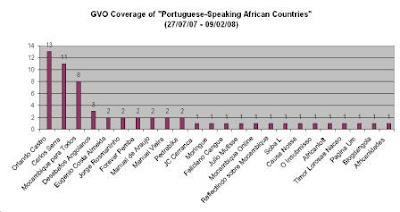
Trying to find some answers, I took a close look at the GVO coverage of “Portuguese-speaking African countries” in the last six months*:

The most striking observation from this graph is that OC appears not only, as we have seen before, as the “undisputed champion” of GVO reporting about the “Angolan blogosphere”, but also as the “champion” (only “disputed” by Carlos Serra, one of the bloggers I covered for GVO) of their “Lusophone” Sub-Saharan Africa reporting. A second interesting observation is that less than one third of the bloggers covered are actually based in Sub-Saharan Africa.

Another, not less interesting, observation is that we get, just to give an example, issues and events about Angola or Sao Tome & Principe covered by East-Timorese or Portuguese blogs – which perhaps shouldn’t come as a surprise considering that some of these blogs are, to put it mildly, “highly influenced” (at least judging from the prominence of his picture on them) by none other than OC, who also appears as the presumable overseer of a “blog production line” (Fabrica de Blogues) spreading from Portugal to Timor. It’s also interesting to observe how OC manages to appear in the coverage of an event in Mozambique, which was being thoroughly covered by Mozambican bloggers in situ.

At first sight, one might be tempted to conclude that these trends reflect a lack of diversity of African-based blogs written in Portuguese. However, as it can be gathered from
this list (where, incidentally, my blog doesn’t figure and, by their own admission, is “manipulated” by… exactly, OC), or from this one (where my blog is also not listed) that is not the case.

It is abundantly clear that the GVO “Portuguese-speaking Africa” editorial line is inspired by the concept of “lusofonia”. However, this raises a number of issues, starting with this: just imagine that you are a South African blogger systematically seeing events happening at your doorstep, and that you also blogged about, reported at GVO by British, Nigerian or American bloggers simply because they too are English-speaking and read about it in the conventional mainstream media, or in your own blog? Or that you are a Maurician or Malgache Creole-speaking citizen who finds your local issues covered at GVO by Gabonese, Algerian or Haitian bloggers, in French, just because their countries are also former French colonies? And this kind of examples could go on and on.

But perhaps the most problematic implication of that approach is that the concept of “lusofonia” itself is a highly contentious one and is far from reuniting consensus in all countries involved – not least because, on the one end, the majority of the African populations in those countries are primarily speakers of their own national languages and, on the other, the concept is highly reminiscent of the Portuguese colonial state’s imperial ideology, according to which there was a single “cultural unit” from Minho (extreme North of Portugal) to Timor - as reflected by the spread of the "OC blogging empire"...

The controversy generated by that approach can be gathered, for instance, from this article by a Mozambican professor of African Literatures at a Portuguese University, or from an article by a Brazilian writer and senior government official, whose link can be found on this post, or from another article by the Mozambican author Joao Craveirinha, whose link can be found on this post. However, these ponderous critical perspectives are unceremoniously dismissed as “gritaria” by the Portuguese language editorial team at GVO, which happens to be exclusively integrated by Brazilian citizens.

Now, on the question of who gets to determine, and under whose criteria, which are “the most interesting conversations and perspectives emerging from citizens’ media around the world”, as per the GVO “Primary Goals”?, let’s just look at some examples taken at random:

- How is it decided that
this criticism of the publication for the first time in the Portuguese market of a magazine directed at African women is “more interesting” than, say, the criticisms arising from this, or this?

- How is it decided that
this treatment of the “Miss Landmine Angola Pageant” is “more interesting” than, say, this one?

- How is it decided that
this presentation of an Angolan music/dance genre is “more interesting” than, say, this one (where the main message is that “Angola is good for everybody except for Angolans”), or any of these (where the rising voices and social consciousness of a new generation of Angolan musicians appear loud and clear)?

- How is it decided that
this tribute to Ian Smith is “more interesting”, than, say, something like this?

- How is it decided that this anonymous email message is credible and "more interesting" than any other possible account of the reality on the ground, such as these, or any of these?

- How is it decided that this account of the EU-Africa Summit is "more interesting than, say, this one?

- How is it decided that an event like this “is not interesting”?

Finally, how can GVO’s “loud silence” about
this event be explained? The same GVO whose mission includes things like, “shining light on places and people other media often ignore (…) to make sense of it all, and to highlight things that bloggers are saying which mainstream media may not be reporting (…) to help people speak out in places where powerful forces would prevent them from doing so (…) and to enable more people whose voices and views are not heard to speak out online.”
The same GVO where articles like this, for example, can be read?

*N.B.: To be accurate, in all 6 instances where my blog appears on GVO links during the period under analysis, it was not on the initiative of the Portuguese-language editorial team. So, they shouldn't be included in this graph because, for all intents and purposes, this blog was excluded from their reporting in the last six months.
In the previous post, I raised, among others, the following questions:

Firstly, what is exactly the “mainstream media”? Does it include the same type of outlets in New York, Lisbon, Luanda, Boston, Porto, Brazilia, Maputo, London, Praia, Vila Nova de Gaia, Rio, Lubango or Dili? Secondly, to what extent can a blogger based in Portugal, USA, UK or Cabo Verde accurately reflect the voices of communities and individual citizens in N’Dalatando, Quelimane or Principe, whose concerns might not be heard online? Can such a blogger in any case reflect them better than another one based closer to those communities, unless he visits them regularly or has close family, friendship, or professional ties with them? Thirdly, who gets to determine, and under whose criteria, which are “the most interesting conversations and perspectives emerging from citizens’ media around the world”, as per the GVO “Primary Goals”?

Trying to find some answers, I took a close look at the GVO coverage of “Portuguese-speaking African countries” in the last six months*:

The most striking observation from this graph is that OC appears not only, as we have seen before, as the “undisputed champion” of GVO reporting about the “Angolan blogosphere”, but also as the “champion” (only “disputed” by Carlos Serra, one of the bloggers I covered for GVO) of their “Lusophone” Sub-Saharan Africa reporting. A second interesting observation is that less than one third of the bloggers covered are actually based in Sub-Saharan Africa.

Another, not less interesting, observation is that we get, just to give an example, issues and events about Angola or Sao Tome & Principe covered by East-Timorese or Portuguese blogs – which perhaps shouldn’t come as a surprise considering that some of these blogs are, to put it mildly, “highly influenced” (at least judging from the prominence of his picture on them) by none other than OC, who also appears as the presumable overseer of a “blog production line” (Fabrica de Blogues) spreading from Portugal to Timor. It’s also interesting to observe how OC manages to appear in the coverage of an event in Mozambique, which was being thoroughly covered by Mozambican bloggers in situ.

At first sight, one might be tempted to conclude that these trends reflect a lack of diversity of African-based blogs written in Portuguese. However, as it can be gathered from
this list (where, incidentally, my blog doesn’t figure and, by their own admission, is “manipulated” by… exactly, OC), or from this one (where my blog is also not listed) that is not the case.

It is abundantly clear that the GVO “Portuguese-speaking Africa” editorial line is inspired by the concept of “lusofonia”. However, this raises a number of issues, starting with this: just imagine that you are a South African blogger systematically seeing events happening at your doorstep, and that you also blogged about, reported at GVO by British, Nigerian or American bloggers simply because they too are English-speaking and read about it in the conventional mainstream media, or in your own blog? Or that you are a Maurician or Malgache Creole-speaking citizen who finds your local issues covered at GVO by Gabonese, Algerian or Haitian bloggers, in French, just because their countries are also former French colonies? And this kind of examples could go on and on.

But perhaps the most problematic implication of that approach is that the concept of “lusofonia” itself is a highly contentious one and is far from reuniting consensus in all countries involved – not least because, on the one end, the majority of the African populations in those countries are primarily speakers of their own national languages and, on the other, the concept is highly reminiscent of the Portuguese colonial state’s imperial ideology, according to which there was a single “cultural unit” from Minho (extreme North of Portugal) to Timor - as reflected by the spread of the "OC blogging empire"...

The controversy generated by that approach can be gathered, for instance, from this article by a Mozambican professor of African Literatures at a Portuguese University, or from an article by a Brazilian writer and senior government official, whose link can be found on this post, or from another article by the Mozambican author Joao Craveirinha, whose link can be found on this post. However, these ponderous critical perspectives are unceremoniously dismissed as “gritaria” by the Portuguese language editorial team at GVO, which happens to be exclusively integrated by Brazilian citizens.

Now, on the question of who gets to determine, and under whose criteria, which are “the most interesting conversations and perspectives emerging from citizens’ media around the world”, as per the GVO “Primary Goals”?, let’s just look at some examples taken at random:

- How is it decided that
this criticism of the publication for the first time in the Portuguese market of a magazine directed at African women is “more interesting” than, say, the criticisms arising from this, or this?

- How is it decided that
this treatment of the “Miss Landmine Angola Pageant” is “more interesting” than, say, this one?

- How is it decided that
this presentation of an Angolan music/dance genre is “more interesting” than, say, this one (where the main message is that “Angola is good for everybody except for Angolans”), or any of these (where the rising voices and social consciousness of a new generation of Angolan musicians appear loud and clear)?

- How is it decided that
this tribute to Ian Smith is “more interesting”, than, say, something like this?

- How is it decided that this anonymous email message is credible and "more interesting" than any other possible account of the reality on the ground, such as these, or any of these?

- How is it decided that this account of the EU-Africa Summit is "more interesting than, say, this one?

- How is it decided that an event like this “is not interesting”?

Finally, how can GVO’s “loud silence” about
this event be explained? The same GVO whose mission includes things like, “shining light on places and people other media often ignore (…) to make sense of it all, and to highlight things that bloggers are saying which mainstream media may not be reporting (…) to help people speak out in places where powerful forces would prevent them from doing so (…) and to enable more people whose voices and views are not heard to speak out online.”
The same GVO where articles like this, for example, can be read?

*N.B.: To be accurate, in all 6 instances where my blog appears on GVO links during the period under analysis, it was not on the initiative of the Portuguese-language editorial team. So, they shouldn't be included in this graph because, for all intents and purposes, this blog was excluded from their reporting in the last six months.

Sunday, 10 February 2008

INTERROGATING THE BLOGOSPHERE (I)


Six months have passed since my last post in what turned out to be a very brief voluntary collaboration with GVO. So, I saw it fit to initiate this series of reflections on my life in the blogosphere so far with that experience.

When I started this journey in the blogosphere just over a year ago, I knew virtually nothing about it. I had accidentally come across one or two blogs before and that was it. So, when I was invited by the Sub-Saharan Africa editor of GVO to collaborate with them, covering the "Portuguese-speaking African countries", it took me a while to accept it but I eventually decided to take on the challenge – and how I knew from the beginning how much of a challenge it would be! I took it mainly as an opportunity to, as I gradually got to know the “lusosphere”, report about it, in English, to the global online community. So, to me it was all about “juntar o util ao agradavel”.

I set out without any particular agenda whatsoever, if not just because I didn’t know at all what I was about to find. But I had a very clear idea, guided by the GVO Manifesto and Mission Statement, that my work would be aimed at “shining light on places and people other media often ignore (…) to make sense of it all, and to highlight things that bloggers are saying which mainstream media may not be reporting (…) to help people speak out in places where powerful forces would prevent them from doing so (…) and to enable more people whose voices and views are not heard to speak out online.”

Well, I may have arrived at the blogosphere as naïve as a nun straight out of a convent, but I was (am) all but naïve about the real world. A real world where I have seen so many organisations, projects and people theoretically motivated by some of the most noble of principles, aims and objectives but, given the opportunities created by lack of transparency and accountability, the pursuit of individual agendas, or other factors such as ignorance, short-sightedness, personal insecurities and lack of professionalism, in practice easily turn into arrogant, megalomaniac, insensitive monsters practicing the exact opposite of what they claim to profess.

More to the point: even though, at the start of my “mission” with GVO, I had gone through a very rough path of conflicts with pornographic, racist and extreme-right sectors of the “lusosphere” who seemed not to have any other purpose in life than to attempt by all means necessary to harass me and tarnish my reputation in the blogosphere, both in mine and other blogs, I had no intention of, on my reporting for GVO, sidelining anyone who might have sided with them, by words, deeds or omissions, provided that their blog posts met the GVO principles and objectives – and this much I clearly stated in the introduction to my first post for GVO.

So, I started with a blog based in Portugal through which the global world, using its comprehensive blogroll, could access virtually the entire “lusosphere”. Thereafter, my main concern was to give utmost priority to bloggers based in the countries I was supposed to cover. This led me to follow up my reporting with the first blog I found in the Mozambican blogosphere, and then with one of the few blogs reporting from inside Angola. My reporting took the form of “bloggers profiles” mainly because of the relatively fewer number of blogs in those countries and their geographical and thematic dispersion. In my choices, there were no considerations of race, gender, politico-ideological orientation or any other subjective factors. There was, however, a clear concern with whether the issues they were blogging about were of the kind that may not be reported by the mainstream media, either in the respective countries or abroad.

And this is where things got complicated. Firstly, what is exactly the “mainstream media”? Does it include the same type of outlets in New York, Lisbon, Luanda, Boston, Porto, Brazilia, Maputo, London, Praia, Vila Nova de Gaia, Rio, Lubango or Dili? Secondly, to what extent can a blogger based in Portugal, USA, UK or Cabo Verde accurately reflect the voices of communities and individual citizens in N’Dalatando, Quelimane or Principe, whose concerns might not be heard online? Can such a blogger in any case reflect them better than another one based closer to those communities, unless he visits them regularly or has close family, friendship, or professional ties with them? Thirdly, who gets to determine, and under whose criteria, which are “the most interesting conversations and perspectives emerging from citizens’ media around the world”, as per the GVO “Primary Goals”?

Before attempting to answer any of these questions, let me talk about the reactions to my third, and eventually last, post for GVO. It was attacked, or rather, I was attacked because of it, on that blog by a group of lusophone bloggers led by one certain Orlando Castro (OC) and including the first blogger I had covered for GVO, on the absolutely groundless and personally insulting libel that “unlike the author of that blog, I had fled Angola without thinking!” Well, this is someone I don’t know and doesn’t know me personally apart from the blogosphere (the same applying to all the bloggers I’ve come across so far) and with whom, I must stress, I never had exchanged any comments or dialogues, directly or indirectly (in fact, I only got to properly know his blog after taking that blow on the stomach from him completely out of the blue) and I might even, as I went on with my work, if allowed to, at some point cover his and his group’s blogs.

The origin of that totally unprovoked and absurd libellous attack about my alleged “flight” from Angola, with or without thinking, is well determined in the “lusosphere”, as are the motivations of its author, and I had it thrown at my face before by the people who have been keeping me under siege in the blogosphere and have forced me to temporarily restrict access to my blog and implement comment moderation on it (costing me a considerable number of visitors, commentators, friends and contributors) and also forced me to get an interview I had given to the blog Szavanna about Angolan music withdrawn.
However, to this day I struggle to understand what led OC to come up with it at that particular blog I covered for GVO. “Is it because I is black?”, as Ali G would ask, or was it because, unlike the previous two bloggers I had covered, the owner of that blog happens to be black? Or was it because I am a woman? Was it because that was the first Angolan-based blog I covered? Or did he think that his blog should have been the first to be covered? Or was it something to do with the subject matter of the post covered itself? I honestly don’t know.

What I have no doubts about is that OC and his followers descended there like a tonne of bricks upon me mainly to personally profit in one way or another from the exposure that blog would gain as a result of its appearance on GVO – interestingly enough, even before I started volunteering for GVO, I had made a comment on that blog (although only to get back a cold shoulder from its author, which I totally failed to understand at the time) and had at some stage linked it on my blog; however I don’t remember ever seeing there before a comment by OC or his friends, or the blog in question figuring in their blogrolls, or vice-versa.

However, the most disturbing of it all for me was that, as if I were carelessly poking a cobra with a very short stick, the supposed potential beneficiary of my voluntary time, effort and attention in that particular instance, in a fit of irrational hatred that I can only understand as the result of the most explosive mixture of ignorance, bad manners, inferiority and subaltern complexes and inversed racism, sided with OC against me, thus effectively behaving like a “turkey voting for Christmas”. This surely caught the attention of someone, somewhere, at GVO, who found in my attackers “the courage of their convictions”! The result?*

Still had any doubts that crime (in this case, opportunism, racism, bullying, intrigue, slander, defamation and libel) actually does pay? So, who is this “suppa duppa dude”, who, clearly as a reward for acting as a deranged sniper bent on forcing me out of my work with GVO and ultimately drive me offline, for allegedly “having fled my country of origin”, all of a sudden started to appear on GVO (I don’t recall his blog ever being mentioned there before) as the “undisputed champion” of blogging about Angola, while continuing undeterred with his vicious, venomous attacks, open or veiled, against me in association with his allies?

For all I know, he is a “professional journalist” (or at least he displays his Portuguese Journalists’ Union card number on his blog profile) who, together with other two bloggers who form among themselves an “exclusive and closed mutual appreciation society” of sorts, works for the mainstream online media outlet “Noticias Lusofonas”, based in Portugal. So, how likely is it that whatever issues he blogs about might not be reported by mainstream media? He is based in an interior locality of Portugal, Vila Nova de Gaia, not even in the capital, Lisboa, or any of the other major cities in the country, such as Porto, Setubal, Faro or Coimbra, where he could have some exposure to and direct contact with the African communities whose majority is based in those centres. So, how reliable can his blog be to reflect the voices of those citizens and of their families in Africa to the global world?

I also happen to know that OC is part of a group of former Portuguese settlers (colonos) who, in 1974, joined UNITA, because its president, Jonas Savimbi, backed by apartheid South Africa, presented himself to them as “the real and only safeguard of white interests in Angola”, while allegedly saying the exact opposite in his speeches in his mother tongue, Umbundu, which most of the white population couldn’t understand (yes, so much for the ‘lusofonia’…). However, he was not among the few whites who stayed in the country after independence in 1975, either fighting Savimbi’s battles on the ground, or on the other side enduring the effects of the long fratricide war, directly or indirectly, as my family and I did, together with the vast majority of Angolans. He fled the country.

Exactly, with or without thinking, he fled Angola in 1975 and never went back! Along the last 30 years, most of Savimbi’s white supporters, inside or outside the country, abandoned his ranks and some are now amongst his main detractors, having become stern defenders of the idea (right or wrong, that’s not what I’m discussing here) that if white interests were ever safeguarded in Angola by any political force, it was by the ruling party, MPLA, and that only they themselves could have done better. However, through his writings, it becomes apparent that he might go back only when “they themselves are in a position of power to do it, because they do it better!” In the meantime, and unlike even some of the most deeply-rooted UNITA militants, he continues to this day to refer to Savimbi as “My President”! So, that’s OC for you.

Most of his and his closest allies’ blog posts about African issues reflect the mentality of those around the world who attribute all African problems exclusively to the “innate incapability” of Africans – to whom he often refers indiscriminately as “monkeys who keep falling from trees because they have to take off one of their shoes in order to be able to count to 12…” – and pretend to pass themselves as “the voices of the voiceless” with an unmistakable, if hidden, ideological agenda: that of advancing, by hook, by crook, or by fluke, the cause of “recolonisation”. His blogging about Angola is all mainly based on reports by the mainstream media in Angola or Portugal and, as a result of that, his opinions are at best secondary and derivative and at worst little more than fabrications of a “fertile imagination”.

He seldom, if ever, reveals “his sources” on the ground, either for the texts or the pictures, (in fact, at least once he used one of my exclusive pictures but, unlike his closest friend, didn't acknowledge it), he publishes about Angola, most of which are not real illustrations of the “facts” and locations he purports to talk about, but selectively chosen to depict the worst possible images of Africa, all invariably reminiscent of the great draught and famine in the Ethiopia of the ‘80s, widely published by the western mainstream media and continually disseminated throughout certain sectors in the blogosphere as the “trademark” image of all countries in Africa, all the time. So, is “citizen’s media” according to GVO based on facts lived and observed in loco, or on second or third-hand, recycled opinion, and clichés produced at a long and safe geographical, cultural and temporal distance?

Now, before I proceed to attempt to find answers to the questions I have been posing, let me say that I am not fighting my causes, whatever they may be, through this. I’ve been fighting my causes, some worthy, others less so, throughout my life by a variety of legitimate means, and achieving whatever goals I might have set to myself in the blogosphere is not dependent on the ‘good will’ of anyone – certainly not anyone at GVO. So, you might ask why am I then making such a fuss about all this, particularly having said at the time that I would rather not elaborate on the reasons for my decision to end my collaboration with GVO? Isn’t this going to generate even more gratuitous publicity and “popular support” for the villains in this story? Shouldn’t I know better, for my blog and my own’s sake, than “messing with the big guys”?

My answer is very simple: because, my dear friends, this is my blog! This is the space where I’m supposed to freely talk about the things that affect me, my life, my family and friends in Africa and the society(ies), real or virtual, geographically close or distant, that I happen to live in, whenever I feel it necessary and appropriate to do so, without fear of persecution, backlash, personal vendettas or any other kind of retaliation.

Ultimately, I believe that it is my right and my duty to interrogate, and hopefully unveil, some of the processes through which certain “powers that be” actually “come to be” to begin with… before some of us start issuing “calls for recolonisation”! Otherwise, what would the blogosphere be for, or is all about, after all?
And, actually, things have reached a point where I have nothing to lose…


*N.B.: To be accurate, in all 6 instances where my blog appears on GVO links during the period under analysis, it was not on the initiative of the Portuguese-language editorial team. So, they shouldn't be included in this graph because, for all intents and purposes, this blog was excluded from their reporting in the last six months.


Six months have passed since my last post in what turned out to be a very brief voluntary collaboration with GVO. So, I saw it fit to initiate this series of reflections on my life in the blogosphere so far with that experience.

When I started this journey in the blogosphere just over a year ago, I knew virtually nothing about it. I had accidentally come across one or two blogs before and that was it. So, when I was invited by the Sub-Saharan Africa editor of GVO to collaborate with them, covering the "Portuguese-speaking African countries", it took me a while to accept it but I eventually decided to take on the challenge – and how I knew from the beginning how much of a challenge it would be! I took it mainly as an opportunity to, as I gradually got to know the “lusosphere”, report about it, in English, to the global online community. So, to me it was all about “juntar o util ao agradavel”.

I set out without any particular agenda whatsoever, if not just because I didn’t know at all what I was about to find. But I had a very clear idea, guided by the GVO Manifesto and Mission Statement, that my work would be aimed at “shining light on places and people other media often ignore (…) to make sense of it all, and to highlight things that bloggers are saying which mainstream media may not be reporting (…) to help people speak out in places where powerful forces would prevent them from doing so (…) and to enable more people whose voices and views are not heard to speak out online.”

Well, I may have arrived at the blogosphere as naïve as a nun straight out of a convent, but I was (am) all but naïve about the real world. A real world where I have seen so many organisations, projects and people theoretically motivated by some of the most noble of principles, aims and objectives but, given the opportunities created by lack of transparency and accountability, the pursuit of individual agendas, or other factors such as ignorance, short-sightedness, personal insecurities and lack of professionalism, in practice easily turn into arrogant, megalomaniac, insensitive monsters practicing the exact opposite of what they claim to profess.

More to the point: even though, at the start of my “mission” with GVO, I had gone through a very rough path of conflicts with pornographic, racist and extreme-right sectors of the “lusosphere” who seemed not to have any other purpose in life than to attempt by all means necessary to harass me and tarnish my reputation in the blogosphere, both in mine and other blogs, I had no intention of, on my reporting for GVO, sidelining anyone who might have sided with them, by words, deeds or omissions, provided that their blog posts met the GVO principles and objectives – and this much I clearly stated in the introduction to my first post for GVO.

So, I started with a blog based in Portugal through which the global world, using its comprehensive blogroll, could access virtually the entire “lusosphere”. Thereafter, my main concern was to give utmost priority to bloggers based in the countries I was supposed to cover. This led me to follow up my reporting with the first blog I found in the Mozambican blogosphere, and then with one of the few blogs reporting from inside Angola. My reporting took the form of “bloggers profiles” mainly because of the relatively fewer number of blogs in those countries and their geographical and thematic dispersion. In my choices, there were no considerations of race, gender, politico-ideological orientation or any other subjective factors. There was, however, a clear concern with whether the issues they were blogging about were of the kind that may not be reported by the mainstream media, either in the respective countries or abroad.

And this is where things got complicated. Firstly, what is exactly the “mainstream media”? Does it include the same type of outlets in New York, Lisbon, Luanda, Boston, Porto, Brazilia, Maputo, London, Praia, Vila Nova de Gaia, Rio, Lubango or Dili? Secondly, to what extent can a blogger based in Portugal, USA, UK or Cabo Verde accurately reflect the voices of communities and individual citizens in N’Dalatando, Quelimane or Principe, whose concerns might not be heard online? Can such a blogger in any case reflect them better than another one based closer to those communities, unless he visits them regularly or has close family, friendship, or professional ties with them? Thirdly, who gets to determine, and under whose criteria, which are “the most interesting conversations and perspectives emerging from citizens’ media around the world”, as per the GVO “Primary Goals”?

Before attempting to answer any of these questions, let me talk about the reactions to my third, and eventually last, post for GVO. It was attacked, or rather, I was attacked because of it, on that blog by a group of lusophone bloggers led by one certain Orlando Castro (OC) and including the first blogger I had covered for GVO, on the absolutely groundless and personally insulting libel that “unlike the author of that blog, I had fled Angola without thinking!” Well, this is someone I don’t know and doesn’t know me personally apart from the blogosphere (the same applying to all the bloggers I’ve come across so far) and with whom, I must stress, I never had exchanged any comments or dialogues, directly or indirectly (in fact, I only got to properly know his blog after taking that blow on the stomach from him completely out of the blue) and I might even, as I went on with my work, if allowed to, at some point cover his and his group’s blogs.

The origin of that totally unprovoked and absurd libellous attack about my alleged “flight” from Angola, with or without thinking, is well determined in the “lusosphere”, as are the motivations of its author, and I had it thrown at my face before by the people who have been keeping me under siege in the blogosphere and have forced me to temporarily restrict access to my blog and implement comment moderation on it (costing me a considerable number of visitors, commentators, friends and contributors) and also forced me to get an interview I had given to the blog Szavanna about Angolan music withdrawn.
However, to this day I struggle to understand what led OC to come up with it at that particular blog I covered for GVO. “Is it because I is black?”, as Ali G would ask, or was it because, unlike the previous two bloggers I had covered, the owner of that blog happens to be black? Or was it because I am a woman? Was it because that was the first Angolan-based blog I covered? Or did he think that his blog should have been the first to be covered? Or was it something to do with the subject matter of the post covered itself? I honestly don’t know.

What I have no doubts about is that OC and his followers descended there like a tonne of bricks upon me mainly to personally profit in one way or another from the exposure that blog would gain as a result of its appearance on GVO – interestingly enough, even before I started volunteering for GVO, I had made a comment on that blog (although only to get back a cold shoulder from its author, which I totally failed to understand at the time) and had at some stage linked it on my blog; however I don’t remember ever seeing there before a comment by OC or his friends, or the blog in question figuring in their blogrolls, or vice-versa.

However, the most disturbing of it all for me was that, as if I were carelessly poking a cobra with a very short stick, the supposed potential beneficiary of my voluntary time, effort and attention in that particular instance, in a fit of irrational hatred that I can only understand as the result of the most explosive mixture of ignorance, bad manners, inferiority and subaltern complexes and inversed racism, sided with OC against me, thus effectively behaving like a “turkey voting for Christmas”. This surely caught the attention of someone, somewhere, at GVO, who found in my attackers “the courage of their convictions”! The result?*

Still had any doubts that crime (in this case, opportunism, racism, bullying, intrigue, slander, defamation and libel) actually does pay? So, who is this “suppa duppa dude”, who, clearly as a reward for acting as a deranged sniper bent on forcing me out of my work with GVO and ultimately drive me offline, for allegedly “having fled my country of origin”, all of a sudden started to appear on GVO (I don’t recall his blog ever being mentioned there before) as the “undisputed champion” of blogging about Angola, while continuing undeterred with his vicious, venomous attacks, open or veiled, against me in association with his allies?

For all I know, he is a “professional journalist” (or at least he displays his Portuguese Journalists’ Union card number on his blog profile) who, together with other two bloggers who form among themselves an “exclusive and closed mutual appreciation society” of sorts, works for the mainstream online media outlet “Noticias Lusofonas”, based in Portugal. So, how likely is it that whatever issues he blogs about might not be reported by mainstream media? He is based in an interior locality of Portugal, Vila Nova de Gaia, not even in the capital, Lisboa, or any of the other major cities in the country, such as Porto, Setubal, Faro or Coimbra, where he could have some exposure to and direct contact with the African communities whose majority is based in those centres. So, how reliable can his blog be to reflect the voices of those citizens and of their families in Africa to the global world?

I also happen to know that OC is part of a group of former Portuguese settlers (colonos) who, in 1974, joined UNITA, because its president, Jonas Savimbi, backed by apartheid South Africa, presented himself to them as “the real and only safeguard of white interests in Angola”, while allegedly saying the exact opposite in his speeches in his mother tongue, Umbundu, which most of the white population couldn’t understand (yes, so much for the ‘lusofonia’…). However, he was not among the few whites who stayed in the country after independence in 1975, either fighting Savimbi’s battles on the ground, or on the other side enduring the effects of the long fratricide war, directly or indirectly, as my family and I did, together with the vast majority of Angolans. He fled the country.

Exactly, with or without thinking, he fled Angola in 1975 and never went back! Along the last 30 years, most of Savimbi’s white supporters, inside or outside the country, abandoned his ranks and some are now amongst his main detractors, having become stern defenders of the idea (right or wrong, that’s not what I’m discussing here) that if white interests were ever safeguarded in Angola by any political force, it was by the ruling party, MPLA, and that only they themselves could have done better. However, through his writings, it becomes apparent that he might go back only when “they themselves are in a position of power to do it, because they do it better!” In the meantime, and unlike even some of the most deeply-rooted UNITA militants, he continues to this day to refer to Savimbi as “My President”! So, that’s OC for you.

Most of his and his closest allies’ blog posts about African issues reflect the mentality of those around the world who attribute all African problems exclusively to the “innate incapability” of Africans – to whom he often refers indiscriminately as “monkeys who keep falling from trees because they have to take off one of their shoes in order to be able to count to 12…” – and pretend to pass themselves as “the voices of the voiceless” with an unmistakable, if hidden, ideological agenda: that of advancing, by hook, by crook, or by fluke, the cause of “recolonisation”. His blogging about Angola is all mainly based on reports by the mainstream media in Angola or Portugal and, as a result of that, his opinions are at best secondary and derivative and at worst little more than fabrications of a “fertile imagination”.

He seldom, if ever, reveals “his sources” on the ground, either for the texts or the pictures, (in fact, at least once he used one of my exclusive pictures but, unlike his closest friend, didn't acknowledge it), he publishes about Angola, most of which are not real illustrations of the “facts” and locations he purports to talk about, but selectively chosen to depict the worst possible images of Africa, all invariably reminiscent of the great draught and famine in the Ethiopia of the ‘80s, widely published by the western mainstream media and continually disseminated throughout certain sectors in the blogosphere as the “trademark” image of all countries in Africa, all the time. So, is “citizen’s media” according to GVO based on facts lived and observed in loco, or on second or third-hand, recycled opinion, and clichés produced at a long and safe geographical, cultural and temporal distance?

Now, before I proceed to attempt to find answers to the questions I have been posing, let me say that I am not fighting my causes, whatever they may be, through this. I’ve been fighting my causes, some worthy, others less so, throughout my life by a variety of legitimate means, and achieving whatever goals I might have set to myself in the blogosphere is not dependent on the ‘good will’ of anyone – certainly not anyone at GVO. So, you might ask why am I then making such a fuss about all this, particularly having said at the time that I would rather not elaborate on the reasons for my decision to end my collaboration with GVO? Isn’t this going to generate even more gratuitous publicity and “popular support” for the villains in this story? Shouldn’t I know better, for my blog and my own’s sake, than “messing with the big guys”?

My answer is very simple: because, my dear friends, this is my blog! This is the space where I’m supposed to freely talk about the things that affect me, my life, my family and friends in Africa and the society(ies), real or virtual, geographically close or distant, that I happen to live in, whenever I feel it necessary and appropriate to do so, without fear of persecution, backlash, personal vendettas or any other kind of retaliation.

Ultimately, I believe that it is my right and my duty to interrogate, and hopefully unveil, some of the processes through which certain “powers that be” actually “come to be” to begin with… before some of us start issuing “calls for recolonisation”! Otherwise, what would the blogosphere be for, or is all about, after all?
And, actually, things have reached a point where I have nothing to lose…


*N.B.: To be accurate, in all 6 instances where my blog appears on GVO links during the period under analysis, it was not on the initiative of the Portuguese-language editorial team. So, they shouldn't be included in this graph because, for all intents and purposes, this blog was excluded from their reporting in the last six months.

Friday, 21 September 2007

TERMINANDO A MINHA COLABORACAO COM O GVO...


... Pelo menos no que respeita a "lusosfera Africana".
Essa foi a decisao a que cheguei depois de profunda ponderacao nas ultimas semanas. Elaborar aqui sobre as razoes talvez ate' fosse um exercicio util e saudavel - so' que eu tambem tinha pensado que aquela "tarefa ingrata" em que me envolvi voluntariamente ha' 3 meses atras o seria - mas, para poupar razoes direi apenas isto: desculpem-me, mas tenho mais que fazer.
Mantenho, no entanto, a minha disponibilidade para colaborar com o GVO em quaisquer outros projectos que nao envolvam o mundo lusofono.

... Pelo menos no que respeita a "lusosfera Africana".
Essa foi a decisao a que cheguei depois de profunda ponderacao nas ultimas semanas. Elaborar aqui sobre as razoes talvez ate' fosse um exercicio util e saudavel - so' que eu tambem tinha pensado que aquela "tarefa ingrata" em que me envolvi voluntariamente ha' 3 meses atras o seria - mas, para poupar razoes direi apenas isto: desculpem-me, mas tenho mais que fazer.
Mantenho, no entanto, a minha disponibilidade para colaborar com o GVO em quaisquer outros projectos que nao envolvam o mundo lusofono.